The first of two posts today, highlighting some of the gorgeous works of African Art that went on sale on 11 May at Sotheby's in New York. Included here are masterpieces several less-commonly-seen artistic traditions, especially the Taureg of Niger (Lot 80), a Brass figure from Chad (Lot 86), an amazing Body Mask from Tanzania (Lot 103), and two funerary figures from Guinea-Bissau (Lots 109 & 110).
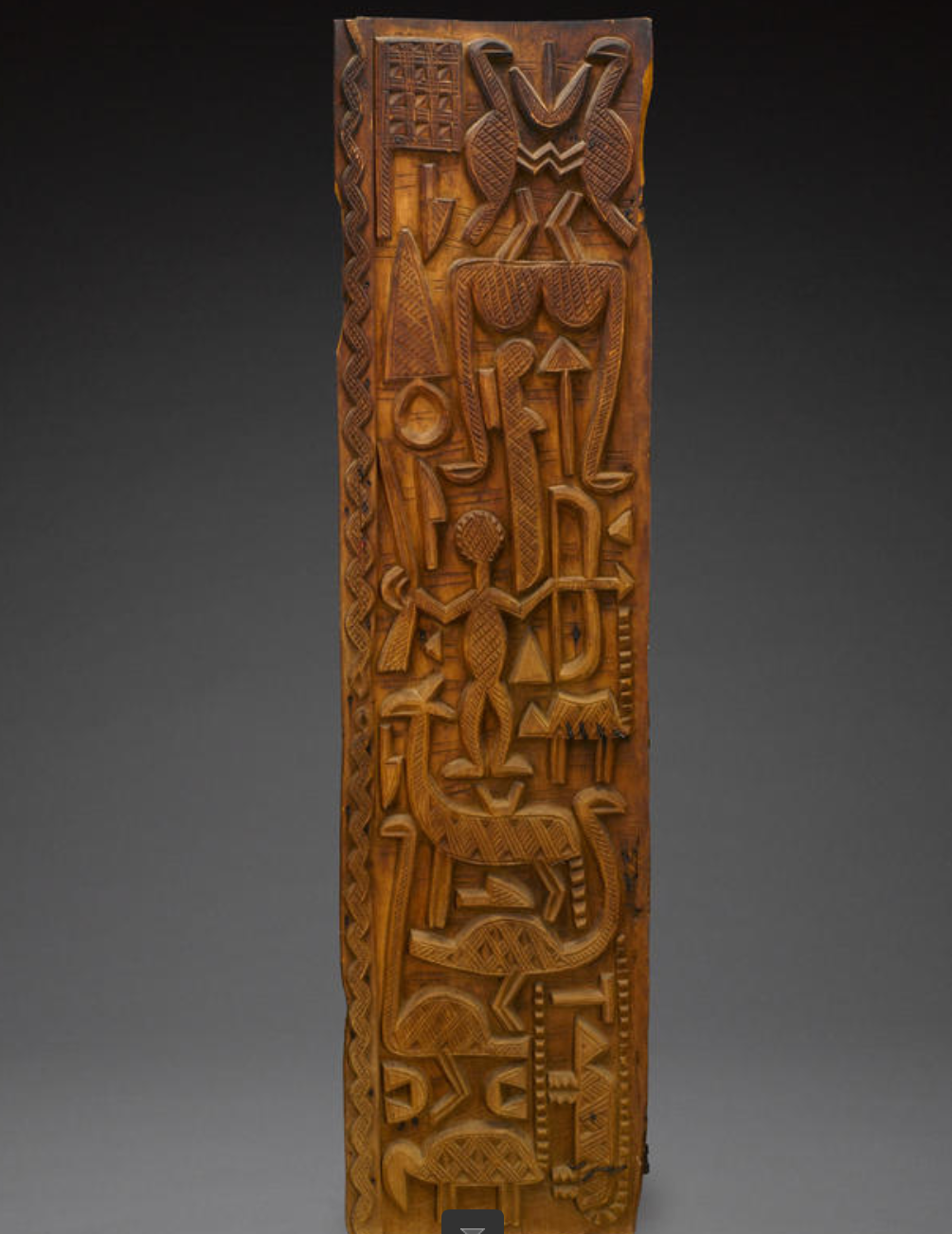
Also below are several incredible iterations of classics, such as the Nupe Door (Lot 100) and an astonishing Yoruba Mask, both from Nigeria (Lot 94), and an animated triple-crested mask from Burkina Faso (Lot 89). The abstract Clay Vessel from Cote D'Ivoire (Lot 98) is also beautiful. Lastly, I've included a highly unusual item (Lot 82) whose association with Henri Matisse saw the mask soar beyond 50 times its original estimate.

LOT 80 TUAREG CUSHION SUPPORT, NIGER
FROM THE COLLECTION OF DRS. NICOLE and JOHN DINTENFASS, NEW YORK
ESTIMATE US$20,000-30,000 Lot Sold: US$56,250
CATALOGUE NOTE
In his discussion of the offered lot on the occasion of the exhibition Africa: The Art of a Continent, René Bravmann (in Phillips 1995: 531, text to cat. 6.57) notes: "Among the Tuaregs of Niger elegantly sculpted cushion supports are important items in any well-appointed household. They were carved by the members of a guild known as Enaden, literally meaning 'the other', blacksmiths who have been instrumental in the creation of precisely those things that have forever distinguished the upper classes of this society (the imochar or warriors and the insilimen or religious teachers) from the many vassal populations of the Tuareg world. [... The] products of the Enaden are among the most potent of hegemonic symbols - for in sitting and reclining upon the pillows and ehel, Tuareg nobles literally sit and lean upon these artists, dramatically re-enacting the historical relationship between themselves and the members of this guild. [...] Ehel such as this example form part of the basic furnishing found in any upper-class Tuareg's tent, itself a hemisphere shaped of exquisitely woven and embroidered mats (asaber or shitek), dominated by geometric bands of subtle colour gradations and highlighted with carefully embroidered designs of dyed twine and leather. The Tuareg living-space appears almost to flaunt its beauty in the face of the desolate Sahel, to represent a private domain imbued with an aura of grace and refinement that defies its natural surroundings. Within these sparkling domes, ehel are used to pin the mat-woven walls against the exterior tent-poles."

LOT 82 LEGA MASK, DEMOCRATIC REPUBLIC OF THE CONGO, WITH POSSIBLE ALTERATIONS BY HENRI MATISSE (1869 - 1954)
THREE AFRICAN AND OCEANIC SCULPTURES FROM THE PRIVATE COLLECTION OF HENRI MATISSE
ESTIMATE US$5,000-7,000 Lot Sold: US$362,500
LOT 84 DOGON ANTHROPOMORPHIC TOGUNA HOUSEPOST, MALI
PROPERTY FROM THE COLLECTION OF SUSAN AND JERRY VOGEL, NEW YORK
ESTIMATE US$12,000-18,000 Lot Sold: US$34,375
EXHIBITED
World Financial Center Courtyard Gallery, New York, Lasting Foundations: The Art of Architecture in Africa (organized by the Museum for African Art, New York), September 30, 2005 - January 6, 2006; additional venues: The Charles H. Wright Museum of African American History, Detroit, through December 15, 2006
Chicago Cultural Center Yates Gallery, Chicago, through April 15, 2007
California African American Museum, Los Angeles, May 17, 2007 - August 19, 2007 National Building Museum, Washington, D.C., October 6, 2007 - January 13, 2008
LOT 86 KOTOKO BRASS EQUESTRIAN FIGURE, CHAD
PROPERTY FROM THE COLLECTION OF SUSAN AND JERRY VOGEL, NEW YORK
ESTIMATE US$3,000-5,000 USD Lot Sold: US$3,125

LOT 89 WINIAMA TRIPLE-CRESTED MASK, BURKINA FASO
PROPERTY FROM THE COLLECTION OF SUSAN AND JERRY VOGEL, NEW YORK
ESTIMATE US$7,000-10,000 Lot Sold: US$10,625
CATALOGUE NOTE
Roy (1987: 214) notes: "The masks of the Winiama and Léla are the most geometric and nonrepresentational of the gurunsi styles. Like the Nunuma, series of lines may radiate from target-shaped eyes, and the geometric patterns painted red, white, and black are similar, although they are applied in different combinations. As a result some Winiama masks may be easily misattributed to the Nunuma or the Bwa. However, the Winiama carve several mask types that include either one or two flat, curving vertical horns paired side-by-side or rising from the top of the head. These horns occur very rarely among the Nunuma and never among the Bwa. The mouths of Winiama masks are usually open lozenge shapes, with angular corners, broad lips, and barred teeth, in contrast to the characteristic Nunuma triangular snout. While the type of animal spirit represented by Bwa, Nuna, or Nunuma masks is usually easy to identify, Winiama masks are often so stylized that they resemble no recognizable animal."
Wheelock (in Roy and Wheelock 2006: 400, cat. 90) adds that these masks exist in single, double, and triple-crested examples. For related masks see Schaedler (1973: 59, fig. 63); Roy (1987: figs. 196 and 197); Roy and Wheelock (2006: cats. 86-90).

LOT 94 YORUBA-IJEBU MASK FOR THE EKINE CULT, DEPICTING THE WATER SPIRIT IGODO, NIGERIA
PROPERTY FROM THE COLLECTION OF SUSAN AND JERRY VOGEL, NEW YORK
ESTIMATE US$30,000-50,000 USD Lot Sold: US$56,250
CATALOGUE NOTE
One of the most dominant groups in the Yoruba kingdom, the Ijebu took advantage of their position in the mid-coastal region of southern Nigeria and amassed wealth and power by controlling trade routes between the sea and the interior. Discussing a closely related mask in the Metropolitan Museum of Art, New York, Fagg (1982: 39, text to figure 41) notes: "[in the Ijebu region] the monolithic tribality of Yoruba style is impaired by intrusions of Ijo style, supported by (and supporting) the powerful Ekine society of the Ijo, which seems to have been adopted by the southern Yoruba as a way of coming to terms with the sea - an alien element to the originally landlocked Yoruba, but a way of life to the Ijo, who live where possible on pile dwellings over the water and who are the fishermen of the coast. Ekine, meaning in Ijo, "dancing people," exists with its own basically Ijo art style alongside traditionally Yoruba institutions such as the kingship and the Oshugbo, or Ogboni, society, with their own purely Yoruba arts, and there is no great interchange of art forms between them. The main dance group of Ekine is the Agbo, or Magbo, society, to which this mask belongs. It is one of a series of masks which are danced in threes and which include antelope and bush-cow representations."
Drewal (in Drewal and Pemberton 1989: 144) continues: "Among the Ijebu, children born through the intercession of water spirits are known as omolokun ('children of the sea') or elekine ('children of the water spirits'), and are praised in verse: 'Children of the sea with shells on their heads/Rulers today, rulers tomorrow, rulers forever/Fire on their head that water quenches.' [...] An elaborate program of masquerades celebrates the role of water spirits who give birth to such children and affect the welfare of Ijebu coastal communities."
The masks used in such masquerades bear symbols relating to the world of humans as well as the world of the "water people", including animal forms which are akin to water. The offered lot combines a humanoid face with protruding conical eyes, an abstract bird on the forehead, a long "beak" and a stylized serpent carved in relief. For three closely related masks from the same workshop as the present mask photographed in situ, see Carroll (1966: 15, fig. 14). For two more related masks see De la Burde (1973: 30).

LOT 98 KOUAME KAKAHA (BORN TANOH SAKASSOU, IVORY COAST, CA. 1960), CLAY VESSEL, CA. 1995
PROPERTY FROM THE COLLECTION OF SUSAN AND JERRY VOGEL, NEW YORK
ESTIMATE US$6,000-9,000 Lot Sold: US$5,938
Museum for African Art, New York, Material Differences: Art and Identity in Africa, April 10 - August 15, 2003; additional venues:
National Museum of Canada, Ottawa, September 17, 2004 - January 2, 2005
Hamline University, Saint Paul, Minnesota, March 5 - May 22, 2004 Crocker Art Museum, Sacramento, April 2 - June 19, 2005

LOT 100 NUPE DOOR, CARVED BY SAKIWA THE YOUNGER, LAPAI, NIGERIA
PROPERTY FROM THE COLLECTION OF SUSAN AND JERRY VOGEL, NEW YORK
ESTIMATE US$20,000-30,000 Lot Sold: US$25,000
According to Frobenius (quoted in Stevens 1966: 29): "Representational art almost died out among the Nupe after
they were converted to Islam by Mallam Dendo's military expedition about 1830." Stevens (ibid) continues:
"Representational motifs are most commonly used in the carving of door panels, most notably in Lapai (Abuja Emirate) where the carvers of Sakiwa's compound have been instrumental in keeping alive this form of carving, and in Agaie (Bida Emirate) whose carvers operate largely in the Sakiwa tradition."
Among the rich variety of symbolic motifs represented is an assortment of animals as well as representations of man-
made objects, some of which were in the repertoire of the same Nupe carvers that produced such doors: a bow and
arrow, a flintlock pistol, knives, and a Koranic tablet. For two closely related doors photographed in situ at Lapai, as
well as a third which is almost identical to the present door, all carved by Sakiwa the Younger of Lapai see Stevens (
ibid:32 and 34). For additional panels carved by Sakiwa the Younger, see Willett (1971: 240, fig. 235) and Robbins
and Nooter (1989: 534, fig. 1426).

LOT 103 MAKONDE BODY MASK, TANZANIA
ESTIMATE US$12,000-18,000
CATALOGUE NOTE
According to Zachary Kingdon (in Phillips 1995: 175, text to cat. 2.66), among the Makonde both "boys and girls must
undergo a period of seclusion, generally six months, during which they learn songs and dances and are taught various practical activities. [...] Everyone is taught the rules of adult behaviour, about sex and about the rights and obligations
of married life." Female body masks were an important part of the initiation rituals. They represent a young pregnant
woman and were usually carved with a swollen abdomen and full breasts, decorated with scarification patterns.
LOT 109 BIDJOGO SHRINE FIGURE, GUINEA-BISSAU
ESTIMATE US$8,000-12,000
LOT 110 BIDJOGO SHRINE FIGURE, GUINEA-BISSAU
ESTIMATE US$8,000-12,000