Showing posts with label Nigeria. Show all posts

Friday, March 21, 2014

“A Short Drive Through Town”

As she looked for her car key she asked if I must get back right away or would I like to come with her for a short drive through town. 
‘Bori at night is simply fascinating,’ she said… 
She certainly knew the city well, from the fresh-smelling, modern water-front to the stinking, maggoty interior.  
We drove through wide, well-lit streets bearing the names of our well-known politicians and into obscure lanes named after some unknown small fish. Even insignificant city councillors had their little streets… 
I began to wonder whether Jean actually enjoyed driving through these places as she claimed she did or whether she had some secret reason, like wanting me to feel ashamed about my country's capital city. I hardly knew her but I could see she was that kind of person, a most complicated woman.  
We were now back in the pleasant, high-class area. 
‘That row of ten houses belongs to the Minister of Construction,’ she said, ‘They are let to different embassies at three thousand a year each.’ 
So what, I said within myself. Your accusation may be true but you’ve no right to make it. Leave it to us and don't contaminate our cause by espousing it.  
 ‘But that’s another Chief Nanga Street ’ I said aloud, pointing to my left.  
‘No. What we saw near the fountain was Chief Nanga Avenue,’ she said and we both burst out laughing, friends again. ‘I’m not sure there isn’t a Road as well somewhere,’ she said. ‘I know there is a Circle.’ 
Then I promptly recoiled again. Who the hell did she think she was to laugh so self-righteously. Wasn’t there more than enough in her own country to keep her laughing all her days? Or crying if she preferred it?  
‘I have often wondered,’ she said, completely insensitive to my silent resentment, ‘why  don't they call some streets after the many important names in your country’s history or past events like your independence as they do in France and other countries?’ 
‘Because this is not France but Africa,’ I said with peevish defiance. 
She obviously thought I was being sarcastic and laughed again. But what I had said was another way of telling her to go to hell. Now I guessed I knew why she took so much delight in driving through our slums. She must have taken hundreds of photographs already to send home to her relations. And, come to think of it, would she— lover of Africa that she was—would she be found near a black man in her own country?  
…‘I was wondering whether I could see you again,’ 
‘Do you want to?’ 
‘Sure.’ 
‘Why not? Let me call you tomorrow?’
An excerpt from the end of chapter 5 of Chinua Achebe’s A Man of the People, written in 1966. Posted today on the first anniversary of his passing. It’s a shame that, if people read any Achebe at all, it is only his best-known work, Things Fall Apart, which is monumental, but not his only masterpiece. In looking for this passage, which I thought was a brilliant, multivalent telling of an African city, I came across so many other great little moments just in the 137 pages of this story, which I enjoyed just as much as his other books.

Tuesday, March 11, 2014

Liberia to Have a Sovereign Wealth Fund?

A surprising phenomenon has been growing across the African continent over the last few years: plans by more than a dozen African governments to develop Sovereign Wealth Funds. These large pools of government revenues, which are diverted from the current budget and instead invested offshore in financial markets for future savings, rather than spent currently or in-country.

These investment vehicles are much associated with affluent economies such as Singapore, China, or the UAE, and not the desperate circumstances of the world's least developed countries. But they have spread across Africa this decade, and Liberia could be considering establishing its own fund. Below is the better part of a February 13th Reuters article:

Resource-rich African countries are busy setting up sovereign wealth funds, but critics say the funds may not serve the long-term interests of poor countries that still need to invest in basics such as schools and roads. 
Three oil producers, Angola, Ghana and Nigeria, started funds in the last two years. Before them, only Botswana, Gabon and Equatorial Guinea had such schemes. Other countries are following. Zambia and Liberia announced plans for funds last month. Tanzania, Kenya, Uganda, Mauritius, Mozambique and Zimbabwe have similar intentions. 
The funds can serve useful purposes, analysts say. Commodity earnings can be split into one fund for infrastructure and another for savings that can be used as collateral for even bigger amounts. 
"Africa needs higher savings," said Razia Khan, the head of Africa research at Standard Chartered Bank. "If it is done properly, the sovereign wealth fund and the accumulation of long-term savings essentially means that countries are improving their creditworthiness and opening up access to bigger sources of financing on more favourable terms. It does not preclude investment in infrastructure." 
But critics say Africa could reap more from its resources by investing in education, energy, and transport to feed other industries, rather than parking the money in liquid but low-yield assets in safe havens, as sovereign funds tend to do. Many successful wealth funds belong to countries with surpluses and rich citizens, which can afford them. That is not the case with many sub-Saharan African governments struggling to feed or educate their people, said Kwame Owino, the chief executive at the Nairobi-based Institute of Economic Affairs. 
"It would be a luxury to have. The political will may exist, but the economics of it suggest that a sovereign wealth fund is not a good idea for many sub-Saharan countries," he said. 
"In many of these countries as well, transparency is a big problem and the amount of leakage that takes place in public funds is a reason to be concerned." 
Liberia is looking at various models of wealth funds, including Norway's, the world's most transparent sovereign wealth fund, Finance Minister Amara Konneh said. The west African country also wants to avoid the so-called "Dutch disease", where a dependence on resource extraction causes other industries to wither. 
Botswana's $6.9 billion Pula Fund was the continent's most transparent on the Linaburg-Maduell index, with a rating of 6 out of 10. Nigeria's $1 billion kitty had a rating of 4 in the third quarter of 2013. The country added $550 million to the fund in February. 
"We have a real governance deficit," said Aly-Khan Satchu, a Nairobi-based independent analyst. "My concerns are that in a majority of these countries where there is a commodity-related windfall, it is proven already that in those countries the governance is the poorest of all the African countries." He cited Nigeria and Angola as example. 
Angolan President Jose Eduardo dos Santos, who has been in power for more than three decades, appointed his eldest son to run the country's $5 billion fund in 2013. That undermined confidence in how it will be managed, given the country's reputation for squandering or siphoning off petrol dollars...Angola's money bags have been stuffed with cash since the end of the country's civil war in 2002. It is now investing in developed-market equities and bonds issued by sovereign agencies, investment-grade companies, high-yield emerging market assets and Africa's hotel sector. Nigeria's reserve was created in 2011 for three main purposes. One is infrastructure, another is a collective savings account and another is a so-called stabilization fund, to cushion against commodity price shocks. A remaining 15 percent is unallocated.
The brief mention of Liberia is attributed to this January interview with Finance Minister Konneh, in which he states that Liberia is ‘looking’ at a Sovereign Wealth Fund. Liberia is a long way off from having one, and is obviously a much smaller, much poorer, and much less developed economy than even Nigeria, with all that giant country’s poverty, inequality, underdevelopment and other major problems. Yet Nigeria has staggering poverty, but instead of injecting its oil revenues in its own development, it has in the last few years opted to set up a separate, off-shore fund.

While some of the funds may be invested in capital projects, like public infrastructure or stakes in private ventures, a good portion of it stays outside of Africa, invested in bonds and stocks. Instead of investing in children’s health or education, the money purchases US Treasuries. Instead of teachers’ and nurses' salaries, the profits from the crude are going into the pockets of fund managers in fees paid in Geneva, London, and New York. From a Bloomberg report from February on Nigeria’s new fund set-up:

Goldman Sachs, UBS AG and Credit Suisse Group AG were among four managers named in August to help run a $200 million fixed-income fund. Eight more managers will be appointed before the end of June, with two expected to be announced next month, Orji said.

So, not only is the money not injected into the domestic economy, it is sucked up into the global banking industry and first-world finance markets.

This is not necessarily inherently evil: prudent savings for future generations, and global expertise in managing and allocating the proceeds from extractive industry could do a lot of good. The Center for Global Development has covered this topic in some detail over the last few years. In October 2011, it published a brief paper, “What Role for Sovereign Wealth Funds in Africa's Development?” that surveyed the proliferation of Sovereign Wealth Funds across Africa, looking at established funds like those in Botswana, and more recent developments such as those in Angola and Nigeria.

The paper raises a lot of the structural problems latent in a undeveloped, resource-rich economy, such as an inability to accept large injects of capital and the high likelihood and risk that such big accumulations of government cash and authoritarian attempts to disperse that cash within the country’s administrative budget would end badly. The heart of the paper sets out the ideal best practices for a successful SWF.

Which all sounds good, but starting point in so much of the discussion of African SWFs (and much else in the world today) remains the unchallenged notion that global financialization is good.  While acknowledging how incongruous it is for the world’s poorest countries to be launching investment funds, there is little exploration in all this discussion of whether or not more current spending, on infrastructure, on education, on health care, would be a better “investment” in the future than offshore investments in U.S. Treasuries or even just in foreign currencies—piles of cash.

The paper was also published before the launch of Nigeria’s fund, which has hardly been immune from Nigeria’s notorious politics, but more positively may direct some of its investment into Nigeria’s decrepit power sector. In the case of Angola’s Sovereign Wealth Fund, most of what has happened thus far is that the President’s son was appointed manager last June, a controversial Swiss firm as given a huge contract to manage the fund, and a massive expensive London office building was purchased as the fund’s office. The result on the streets of Luanda? The city’s street vendors were harassed by the police and banned from trading.

I know little about economics, but even after reading these papers, the drive to funnel resource revenues into offshore funds still seems a bit shocking, especially in our current age when the over-financialization of even the U.S. economy is widely questioned.

Most startling, and difficult to accept, is the idea that rather than better-paid teachers or more paved roads or clinics, megabanks like Goldman Sachs or politically-connected Swiss-registered outfits will be receiving their fee for managing the assets of the world’s poorest people, who are excluded from enjoying the benefits of their country’s natural resources, and that rather augment public and private spending, by buying low-risk assets such as government bonds or foreign currencies, the world's poorest are essentially lending the world's richest money. 

Saturday, March 8, 2014

Modern Railways, May 1965: New for Nigeria


I've kind of moved on from the posts earlier this week about Nigeria's railways, but here's something I found in the tubes of the internets back in August, the cover of Modern Railways from May 1965:

“New for Nigeria: As part of their expansion program me, the Nigerian Railways, have recently ordered twenty-nine locomotives equipped with Sulzer 6LDA28-C six-cylinder pressure charged diesel engines of 1400 h.p.  The new locomotives will be used for mixed duties on the route from Lagos to Kano in the northern district of the Federation. The main contractors are A.E.I. and the locomotive builders are Metropolitan-Cammeli.”

Monday, March 3, 2014

Lagos Underground

Yesterday's spoof on an imagined Monorail transit system for Monrovia, something I have had hanging around for years, reminded me of Jeremy Weate's 2007 remaining of the London Underground system. As seen in a six-year old post on the Naijablog, Weate took the famous tube map and simply replaced the station names with locations across Lagos.


As excerpted from that blogpost:
As with the London version, I have taken quite a few geographic/artistic licences for the purposes of design clarity and readability. My thinking is ppp: companies with deep pockets could sponsor the design & build of some of the stations to reduce the strain on the public purse, and in return pick the name of their choice (see Zenith, Silverbird, IBTC). On the other hand, some of the station names strongly signal a poetic sense of place, as with Palace (for the Oba’s Palace on Lagos Island), and 1004, standing for the eponymous flats. Again, for ease of use, I have left out the Five Cowrie Creek that separates Lagos Island from Victoria Island below it – those familiar with the morphology of Lagos can project it onto the map in their imagination.
What a joy Lagos would be with this metro system (it could be part overground, and part underground, depending on geology). As with the London version, I have kept a light rail system heading due East towards Ajah and Epe from the shared stations of Lekki/The Palms – this is it to cater for the marshy terrain along the Lekki peninsular.
Just imagine how convenient it would be if Lagos had this metro. The highbrow set could take the Falomo line (Piccadilly renamed) from their Bourdillon mansions to catch a classical music concert at Muson – at last not having to worry about parking and ‘settling’ awon boys; one could shop for a picnic at The Palms, then drink and eat it all on the new-look Bar Beach; or one could stock up on no-one-need-knowjuju fetish-wear at Oyingbo market before heading for the Silverbird cinema (connecting onto the Circle line at Kuramo Waters).
While this is all fun, as in my own case, would that we lived in a world where such public works projects were reality, rather than bloggers' graphic follies. More positively, a light-rail system is in the works for the urban area, supposedly set to open imminently, and various high-speed rail projects are advancing in Nigeria.

Thursday, November 14, 2013

Highlights of Bonham's African Art Auction, 14 November

A few hours ago in New York, Bonham's Auction House held a sale of African and Oceanic Art. As usual, I wasn't in attendance, much less buying anything, but as a small-time collector of African Art, here's a few of the highlight lots, some of which were unsold: 

 There were a large number of headrests in the show. 
Above, Lot 82: A rare Twa pygmy Headrest from Rwanda or Burundi, sold for $5000.
 Lot 106: A Kuba Headrest from the DR Congo, sold for $1250.
 Lot 119: One of three beautiful Zulu headrests, this gorgeous tripod went unsold (guide price $1500)

 Lot 120: Two of three Zulu Headrests, this horse-like item went for $1375.

 Lot 126: Another three-legged Zulu headrest, this one went unsold (guide price $1500).

 Lot 149: [The crying of lot 149!] A gorgeous Bobo bull elephant mask from Burkina Faso, 
sold for $4000.

 Lot 162: The only piece in the sale with a Liberian provenance, this rare Grebo door once was owned by Yale and later by the Brooklyn Museum. Amazingly, it sent unsold (guide price $8000). 

 Lot 182: An incredible Ijo Mask from Nigeria, sold for $8125.

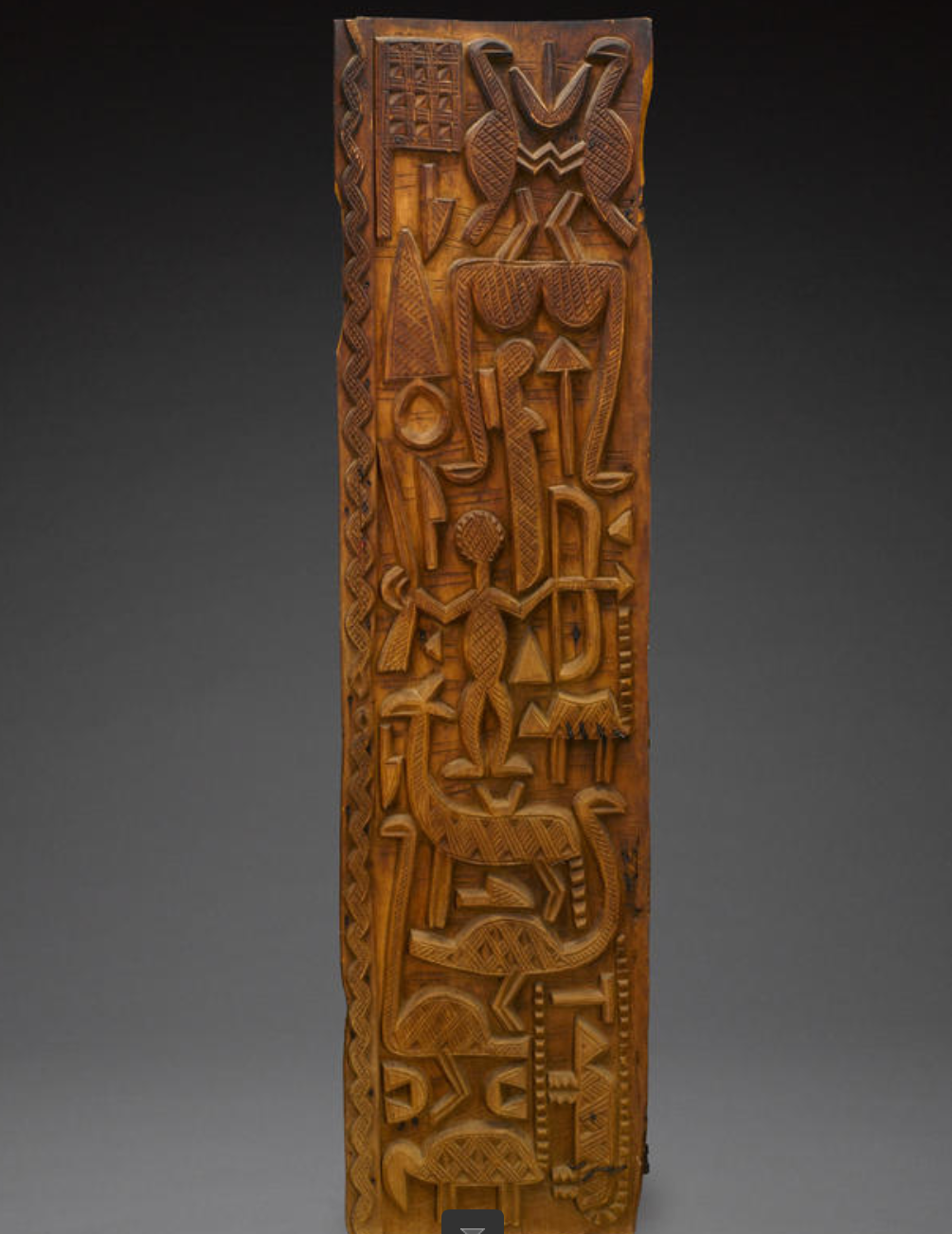
 Lot 187: An intricate Nupe Door from Nigeria, 
possibly attributable to the carver Sakiwa the Younger, sold for $3125.

  Lot 188: A gorgeous Mumuye figure from Nigeria, sold for $4375.
(profile view below)


 Lot 189 A Mambila ancestral figure from Cameroon or Nigeria, sold for $6250.

 Lot 210: A charismatic Pende Giwoyo Mask, from the DR Congo, with its comically solemn expression and grandfatherly beard, unsold (guide price $2500)

 Lot 215: A disk-shaped Mask, used in the Kidumu Society of the Tsai group 
of Teke people from the DR Congo

 Lot 218: A classic; the dynamically-featured Songye Mask, this item was photographed in 1972 in the Congo whence it was sourced(below). Sold for $3500.


Thursday, September 19, 2013

Arik Air's Guide to Nigeria's Cities

In the wake of Air Nigeria's ignominious demise, Arik Air has taken up the mantle of flag carrier for Nigeria, and taken on West Africa's key Lagos-Accra-Monrovia route, which I flew a few months back.
Arik Air's in-flight magazine, Wings, has the usual economy class journalism, but I was delighted by the airline's back section feature, WingTips, which are visitor guides to cities it serves. These include not only the larger global destinations like Johannesburg, but also most of its domestic network, including Akure, Asaba, Gombe, Ilorin, Jos, Kaduna, Katsina, Owerri, Port Harcourt, Sokoto, Uye, Warri, Yola. Each profile has a section, Behold, which celebrates the city itself, followed by paragraphs on what to buy or what local markets the city has, and what or where to eat, and where to stay.
Brussels Airlines and Kenya Airways produce similar content for their in-flight glossies for spots as exotic as Lomé and Conakry, and of course Lonely Planet and other adventure guides have provided information on off-the-beaten-path African cities for decades. So perhaps I am looking at this from the perspective of a patronizing foreigner, but this glossy promotional series was pleasantly unexpected. I find it so warming and optimistic to find these tourist guides to these places, so little known and little visited by foreigners, and broadly speaking so infrequently appreciated or celebrated by just about everyone.
The only time any of these places make it into the international press is likely when there are fear-mongering stories about Nigeria's insecurity or imminent break-up. Rather than danger warnings, its nice to read celebratory recommendations suggesting travelers explore the country.


Tuesday, September 17, 2013

Newly-discovered blog: Naijanomics

Following from yesterday's post on the new Chatham House report on Nigeria's institutionalized oil theft, I just happened to discover, via Twitter, this excellent new blog on Nigerian economics, called Naijanomics, written by Chuba Ezekwesili. I've added it the blog roll (on the right-hand side of the page) and recommend checking it out. The post from today, on 'African Time' analyzed through game theory is pretty clever.

Monday, September 16, 2013

Nigeria's Stolen Oil

Sticking with Nigeria for another day, here's a few startling (or not so surprising) paragraphs:

Nigerian crude oil is being stolen on an industrial scale. Some of what is stolen is exported. Proceeds are laundered through world financial centres and used to buy assets in and outside Nigeria. In Nigeria, politicians, military officers, militants, oil industry personnel, oil traders and communities profit, as do organized criminal groups. The trade also supports other transnational organized crime in the Gulf of Guinea... 
Nigeria offers a strong enabling environment for the large-scale theft of crude oil. Corruption and fraud are rampant in the country’s oil sector. A dynamic, overcrowded political economy drives competition for looted resources. Poor governance has encouraged violent opportunism around oil and opened doors for organized crime. Because Nigeria is the world’s 13th largest oil producer – exports often topped two million barrels per day in 2012 – high rents are up for grabs. 


Those are from the opening passages of the Executive Summary of "Nigeria's Criminal Crude: International Option to Combat the Export of Stolen Oil" authored by Christina Katsouris and Aaron Sayne, and released this week by Chatham House. Free to download here. Eye-opening reading.

Planet Money Podcast on Nigeria's GDP

Speaking of Podcasts, which I am a bit addicted to, in addition to the Africa Today Podcast from the BBC, which comes out 5 days a week, I also subscribe to NPR's Planet Money podcast, which features short, digestive summaries of complex economic stories in the news.

Earlier this year, Planet Money has two episodes about Nigeria and Ghana's GDP calculations. One called, When a Poor Country Gets a Whole Lot Richer, which described the re-adjustment of Nigeria's GDP calculations, moving the baseline year up and accounting for whole sectors such as mobile telephony, resulting in a radically larger GDP figure. Earlier in the year, an episode covered both Ghana's 2010 GDP readjustment as well as emerging tech sectors contributing to Nigeria's GDP reckoning.

I definitely recommend listening to the whole episode via the link above, which is quite illustrative on how GDPs are calculated and informative generally on Nigeria's economic growth, but I also was amazed to hear the episode because I had written an email to Planet Money and recommended this topic for a show. Unfortunately, no love for me in the credits, but still.

Sunday, September 1, 2013

Global Entrepreneurship, Sub-Saharan Entrepreneurs


First, when the overall environment for business is bad, there are many entrepreneurs.  For example, while there is a great deal of variation shown by the data within Africa, it is also clear that this is a difficult place to do business, because, for example, regulation is unpredictable and property rights can be hard to defend against powerful people.
Lack of human capital is also a weakness.  You need capable engineers, managers and many others to help companies grow.  The education system in many African countries is not in good shape.
Yet, there are plenty of potential entrepreneurs in the study: “Sub-Saharan Africa reported the highest intentions of any geographic region (53 percent), which is consistent with their positive perceptions about opportunities and their belief in their capabilities” (Table 2.2).
The explanation is simple.  In such economies, entrepreneurship is a fallback option, when it is not possible to get a decent job in larger business.
The full report is here, wherein the reader will note that, while the GEM Report astonishingly surveyed nearly 200,000 people in 69 countries, representing 87% of the world's GDPs and 74% of its population, only 10 Sub-Saharan African states were included: Nigeria, South Africa, Angola, Botswana, Ghana, Malawi, Mozambique, Zambia, Uganda, Ethiopia, and Namibia. Of these, only Malawi is anywhere close to the developmental stature of present-day Liberia.  

Tuesday, October 2, 2012

Liberia's Arrow Points Backwards


Reposted from the October 2 article in The Economist online, citing a recent report by the World Bank, which compares the increase in GDP per capita with rates of urbanization in Asian Tigers (and China) with sub-Saharan African countries. Strikingly, the African economies do not correlate GDP growth with increasingly urbanized populations, as is markedly the case in the major ASEAN economies and China. Only Ethiopia and Ghana show any similarity, with tiny Guinea-Bissau joining Cameroon and Kenya only slightly tilted in the same direction. Massive Nigeria points straight upwards, stagnating even as its cities have boomed. Zimbabwe and Madagascar actually show a decrease in GDP per capita as those states have urbanized, while the most dramatic outlier is Liberia, which saw a rapid decrease in GDP even as the country's urbanization shot up. The Civil conflict is, of course, major cause of this.

Updated: This was also posted on The Atlantic which has a link to the World Bank's Tumblr.

Thursday, May 24, 2012

Highlights of the African Art Auction at Sotheby's, 11 May 2012 (2 of 2 Posts)

The second of two posts highlighting some of the gorgeous rare African art for sale on 11 May at Sotheby's in New York, including some masterpieces of several cultural groups, including a Dan container (Lot 113) and a Senufo Bird (Lot 196) from Cote D'Ivoire and a Mumuye figure (Lot 122) from Nigeria (see this 2011 post for other, similar examples of Mumuye art), as well as incredible pieces from Gabon (Lots 129 & 132) and stately Bamana (Lot 193) and Dogon (Lot 126) pieces from Mali.

Also below are some beautiful gems from less-commonly seen art traditions, including the grasslands of Cameroon (Lot 121), an amazing Zulu head-rest (Lot 178), and an elephant ivory scepter from DR Congo (Lot 194)--all three mesmerizing as abstract forms as much as fine cultural craft objects. 

The full online catalog of this auction is available at Sotheby's website. As can be seen below, several of these amazing works did not sell at all, while a few others blew pasts their estimates. 


LOT 113 DAN RITUAL CONTAINER IN SHAPE OF A RAM, IVORY COAST
ESTIMATE US$40,000-60,000 USD Lot Sold: US$68,500


CATALOGUE NOTE
Amongst the rarest objects produced by Dan artists are containers in the shape of a ram. Apart from the offered lot, only one other example is recorded in the Ethnografische Verzamelingen of Ghent University in Belgium (Yale Van Rijn archive inv. no. "0123784").
Little is known about the function of these containers. Both containers have a worn surface on top. For the Ghent example the hypothesis has been suggested that it might have served as stool or neckrest. In general, both works seem too large for neckrests. While their sizes and general shape would not be uncommon for stools (cf. one previously in the Renee and Chaim Gross Foundation, Sotheby's New York, May 15, 2009, lot 42), they seem too refined for an object of daily use. Instead, it is conceivable to locate their function in a ritual context. This hypothesis is further supported by traces of palm oil on the offered lot's surface. 


LOT 116 BAULE GONG BEATER, IVORY COAST
ESTIMATE US$5,000-7,000


LOT 119 WE (NGERE) MASK, GERE SUBGROUP, IVORY COAST
ESTIMATE US$40,000-60,000 Lot Sold: US$59,375 


CATALOGUE NOTE
The present mask, illustrated alongside the essay on Dada and Surrealism on the occasion of William Rubin's 1984 monograph "Primitivism" in 20th Century Art: Affinities of the Tribal and the Modern, is a conceptual masterpiece of Guere art. In her recent study on We and Guere masks, Marie-Noël Verger-Fèvre (2005: 111) identifies it as either war (te'e gla) or wisdom (gla kla'a) mask. According to this study (loc. cit.: 107-108), the war mask "belongs to the category of great masks by virtue of its age and of its importance in the lineage to which it belongs. This mask once played a prominent role in We lineages because it intervened in matters of tribal warfare, which was widespread before the arrival of European colonials. [...] The great mask of wisdom, gla kla'a, appears in public on rare and solemn occasions. It is present at commemorative ceremonies and the funerary rites of important individuals and high Gla dignitaries. It also appears once every decade or so, apparently for the singular purpose of exhibiting it. Whenever it appears, the full procession of masks takes place before it." 


LOT 120 NUNUMA CROCODILE MASK, BURKINA FASO
ESTIMATE US$20,000-30,000 
  
LOT 121 CAMEROON GRASSLANDS BELLOWS, CAMEROON
PROPERTY FROM THE COLLECTION OF ERIC EDWARDS, NEW YORK
ESTIMATE US$7,000-10,000 Lot Sold: US$7,500


LOT 122 MUMUYE ANCESTOR FIGURE, NIGERIA
ESTIMATE US$40,000-60,000 Lot Sold: US$110,500 


CATALOGUE NOTE
Mumuye figures represent the human form with strikingly abstract elongated shapes, ingeniously playing upon positive and negative space with openwork subtraction from a columnar whole. Kerchache (1988: 546) notes: "[Mumuye] statuary does not depict ancestors but rather incarnates tutelary spirits. Yet, statues reinforce the status and prestige of their owner who, as he holds them in his hands, has a dialogue with them and thus ensures his personal protection."
For a closely related figure see Leuzinger (1985: pl. 72b).


LOT 128 YORUBA-OWO IVORY ORNAMENT, NIGERIA
Made of African Elephant (Loxodonta africana) ivory, with Coconut shell inlay.
ESTIMATE US$100,000-150,000 Lot Sold: US$254,500 


CATALOGUE NOTE
In his discussion of the offered lot on the occasion of the exhibition Africa, The Art of a Continent at the Guggenheim Museum in New York, Ekpo Eyo (in Phillips 1995: 138) noted: "Among the Owo-Yoruba, a red costume (orufaran) is worn by the highest ranking chiefs as a priviledge granted by the king (olowo). [...] It consists of a top shirt made of imported red flannel that is scalloped to resemble the scales of an anteater or pangolin. Like the scales of a pangolin, the costume protects its wearer from harm by rendering him invulnerable. Sewn onto the scalloped shirt are a series of carved ivory ornaments (omama) depicting powerful animals such as the ram, crocodile, leopard, or horse. [...] The ram omama shown here, one of a pair (the other is in the Metropolitan Museum of Art in New York [inv. no. "1991.17.123"]), probably came from the orufaran of the chief (ojomo) of Ijebu quarter, originally located on the outskirts of Owo town proper. [...] If he inherited the costume from the first ojomo, Oladipe, then it can be dated to the last quarter of the eighteenth century. The pair of omama were very likely made by the same carver."
Drewal (in Ross 1992, p. 199) continues: "Together with the elephant, the ram is the most important totem among the Yoruba. It is a sign of the preeminent power and aggressiveness of one who tolerates no rival." 


LOT 129 FANG ARMLET MASK, GABON
FROM THE COLLECTION OF CECILLE & MICHAEL PULITZER, SANTA BARBARA
ESTIMATE US$7,000-10,000     
LOT 132 MAHONGWE RELIQUARY FIGURE, GABON
ESTIMATE US$30,000-50,000 Lot Sold: 62,500

LOT 134 KWELE ANTELOPE MASK, REPUBLIC OF CONGO
ESTIMATE US$150,000-250,000


CATALOGUE NOTE
Museum, London (Trowell and Nevermann 1968: 70); a third in the Musée Dapper, Paris (collected by Aristide Courtois before 1938, Falgayrettes-Leveau 1995: 61); a fourth in the Kulturen Museum, Lund (inv. no. "51.467.113"); and a fifth in the Etnografiscka Museum, Gothenburg (Leuzinger 1970: 241, pl. Q 9).
Kwele antelope are exceedingly rare. Several related masks are recorded in important museum collections: one in the Musée Barbier-Mueller, Geneva (inv. no. "1019-49", Schmalenbach 1988: 210, cat. 127); a second in the in the British
Hahner-Herzog (1998: text to cat. 69) notes: "The rare masks of the Kwele, a little-investigated ethnic group of northeast Gabon and the adjacent area of the Republic of Congo, are associated with the Bwete association, which maintains social order. The masks are also used in initiation rites and at the end of periods of mourning. Representing benevolent forest spirits, they have zoomorphic or anthropomorphic traits, or a combination of the two. The faces are usually painted in white kaolin earth, a pigment associated by the Kwele with light and clarity, the two essential factors in the fight against evil."
Discussing the aforementioned Barbier-Mueller mask, she continues: "The rare Kwele masks with vertically projecting horns exhibit a range of stylistic differences. Some examples, such as the one illustrated here and those in Göteborg and London depict antelopes."


LOT 136 DOGON RITUAL OBJECT, MALI
MINIATURE SCULPTURE FROM THE COLLECTION OF MARTIN AND ROBERTA LERNER
ESTIMATE US$8,000-12,000

CATALOGUE NOTE    
This fine figural-architectural sculpture features a seated figure above a tall flat form, with geometric
openwork, resembling the hilt of a knife. Several related works are known: 
see one in the Seattle Art Museum (inv. no. "67.53"); and another offered at Sotheby's Paris, December 5, 2003, lot 112. All share in common small pieces of metal which preclude the presence of a blade where it would be expected, and indeed seem too thin and broad to be handles. These metal pieces were seemingly for the addition of an unknown attachment though none with any such attachment is known. Although the specific use of this enigmatic object remains a mystery, the layered patina attests to its function within sacred ceremonies, as the refined quality of the sculpture does to its ritual importance. 


LOT 175 NGOMBE STOOL, DEMOCRATIC REPUBLIC OF THE CONGO
ESTIMATE US$8,000-12,000 Lot Sold: US$8,125 
LOT 178 ZULU NECKREST, SOUTH AFRICA
ESTIMATE US$6,000-9,000


LOT 191 BEMBE JANUS HELMET MASK FOR THE ALUNGA SOCIETY, DEMOCRATIC REPUBLIC OF THE CONGO echawokaba/echwaboga. 
ESTIMATE US$40,000-60,000 Lot Sold: US$50,000


CATALOGUE NOTE
Discussing a related mask in the Musée Barbier-Mueller, Geneva, Hahner-Herzog (1998: text to cat. 96) notes: "This mask represents a type of mask which, according to the Bembe, goes back to the Bahonga, a hunting and gathering people whose collecting of honey is said to have been done under the tutelage of this mask. With the Bembe it is called ibulu lya alunga or echwaboga, represents a bush spirit (m'ma mwitu), and belongs to the accessories of the hierarchically ordered Alunga men's association. The mask is used during acceptance ceremonies for new, usually young members, as well as in hunting rites. For public appearances the carved helmet is decorated with an elaborate headdress of feathers and porcupine (ehala) quills, and a neck fringe of fibers. The dancer is clad in a multilayered fiber costume (asamba). These impressive Alunga masks are invariably conceived in the form of cylindrical helmets with two, as it were, Janus faces, whose black rhombic or cross-shaped eyes with protruding pupils are set in large oval hollows painted white. Due to these striking facial features the masks have been interpreted as representing owls, with which the masqueraders in fact occasionally identify. In addition, the two faces are intended to invoke the all-seeing nature of the mask spirit, a capacity which enables him to reconcile the opposing forces of nature, such as male/female or day/night." 


LOT 193 BAMANA OR MANINKA HELMET MASK, MALI
PROPERTY FROM THE COLLECTION OF ZAFRIRA AND ITZHAK SHOHER, TEL AVIV
ESTIMATE US$25,000-35,000 Lot Sold: US$26,875 


CATALOGUE NOTE
(1995: 60). Another closely related mask, also previously owned by the Carlebachs, is in the Menil Collection in Houston (inv. no. "X 0039"). Describing that example, Malé (in Van Dyke 2008: 62) notes: "In the context of initiation, its role is evoked by the phrase ba kara misi; according to Youssouf Tata Cissé, quoted in Tal Tamari (2001: 101- 102), 'this designation is composed of ba (mother, basis) and kara (perfect circle, creation spirit, divine spirit); one could translate this expression as foundational circles symbolizing the divine spirit [...]. Accordingly, the various elements of the misikun mask seek this formal perfection."
For a closely related domed, horned, faceted helmet mask in the Musée Dapper, Paris, see Falgayrettes-Leveau 
He continues: "The misikun mask is attached to a wearable marionette in an ensemble worn by two performers. [...] When it appears on the scene, the misiba [cow] walks around the area with a serene, graceful gait, and then stops in the middle of the village. During this promenade the shepherd raises and lowers the stick like a rider encouraging his steed. When the marionette stops moving, the young women intone the popular song "Misiba", composed in honor of generous men. The misiba symbolizes generosity among the Bamana and Maninka. [...] The performance teaches the duty of protecting those who are generous. Whereas the mask represents simply a bovid, the marionette evokes a more specific contribution of ploughing cattle to the local agriculture production; through other songs, tribute is paid to their labor." 

LOT 194 LEGA IVORY SCEPTER, DEM. REPUBLIC OF THE CONGO
African Elephant (Loxodonta africana) ivory. 
PROPERTY FROM THE COLLECTION OF ZAFRIRA AND ITZHAK SHOHER, TEL AVIV
ESTIMATE US$6,000-9,000
   
LOT 196 SENUFO BIRD STATUE, IVORY COAST
PROPERTY FROM THE COLLECTION OF ZAFRIRA AND ITZHAK SHOHER, TEL AVIV
ESTIMATE US$70,000-100,000 Lot Sold: US$86,500 


CATALOGUE NOTE
Koulotiolo, creator of the world, a distant and inaccessible diety. On the other hand, the mother of the village, Katieleo, regenerates the world and redeems humankind through the initiation rites of the poro. [...] A male villager who has not been initiated will be excluded from the village and will lose his rights as a citizen."
According to Kerchache (1988: 512) for the Senufo, the poro association "[...] is the pillar of communal life. Responsible for the initiation and training of the young boys, it is aimed at shaping an accomplished, social man who is integrated into the collective; it aids his entry into public responsibilities. [...] The Senufo believe in a god, 
Garrard (in Phillips 1996: 457) notes: "In former times many of the men's secret Poro societies in the Senufo region owned a large standing sculpture of a bird. This statue, kept in the sacred forest, was used in the rites for the admission of initiates to the final phase of training. It generally had a hollowed base, which permitted it to be carried on the head of an initiate. Some examples also have holes in the wings, through which cords were passed to steady the bird when carried. [...] Older Senufo [...] usually name it as sejen or fijen [...] a term that simply means 'the bird'. The significance of this bird is indicated more clearly by two other names. It is sometimes called kasingele, 'the first ancestor', which may refer either to the mythological founder of the human race or to the ancestral founder of the sacred forest. Alternatively, it is named poropia nong, which means literally 'mother of the Poro child'. The statue is thus a primary symbol of the Poro leadership, indicating the authority of its elders."
The morphology of these rare statues references both male and female characteristics, with the swollen, pregnant belly, and the elongated phallic beak. A related figure is in the Metropolitan Museum of Art, New York (inv. no. "1978.412.382"). 
LOT 197 SALAMPASU MASK, DEMOCRATIC REPUBLIC OF THE CONGO
PROPERTY FROM THE COLLECTION OF ZAFRIRA AND ITZHAK SHOHER, TEL AVIV
ESTIMATE US$25,000-35,000

 LOT 198 LEGA FIGURE, DEMOCRATIC REPUBLIC OF THE CONGO
PROPERTY FROM THE COLLECTION OF ZAFRIRA AND ITZHAK SHOHER, TEL AVIV
ESTIMATE US$10,000-15,000 Lot Sold: US$25,000

Tweets by @moved2monrovia