Showing posts with label DR Congo. Show all posts

Thursday, November 14, 2013

Highlights of Bonham's African Art Auction, 14 November

A few hours ago in New York, Bonham's Auction House held a sale of African and Oceanic Art. As usual, I wasn't in attendance, much less buying anything, but as a small-time collector of African Art, here's a few of the highlight lots, some of which were unsold: 

 There were a large number of headrests in the show. 
Above, Lot 82: A rare Twa pygmy Headrest from Rwanda or Burundi, sold for $5000.
 Lot 106: A Kuba Headrest from the DR Congo, sold for $1250.
 Lot 119: One of three beautiful Zulu headrests, this gorgeous tripod went unsold (guide price $1500)

 Lot 120: Two of three Zulu Headrests, this horse-like item went for $1375.

 Lot 126: Another three-legged Zulu headrest, this one went unsold (guide price $1500).

 Lot 149: [The crying of lot 149!] A gorgeous Bobo bull elephant mask from Burkina Faso, 
sold for $4000.

 Lot 162: The only piece in the sale with a Liberian provenance, this rare Grebo door once was owned by Yale and later by the Brooklyn Museum. Amazingly, it sent unsold (guide price $8000). 

 Lot 182: An incredible Ijo Mask from Nigeria, sold for $8125.

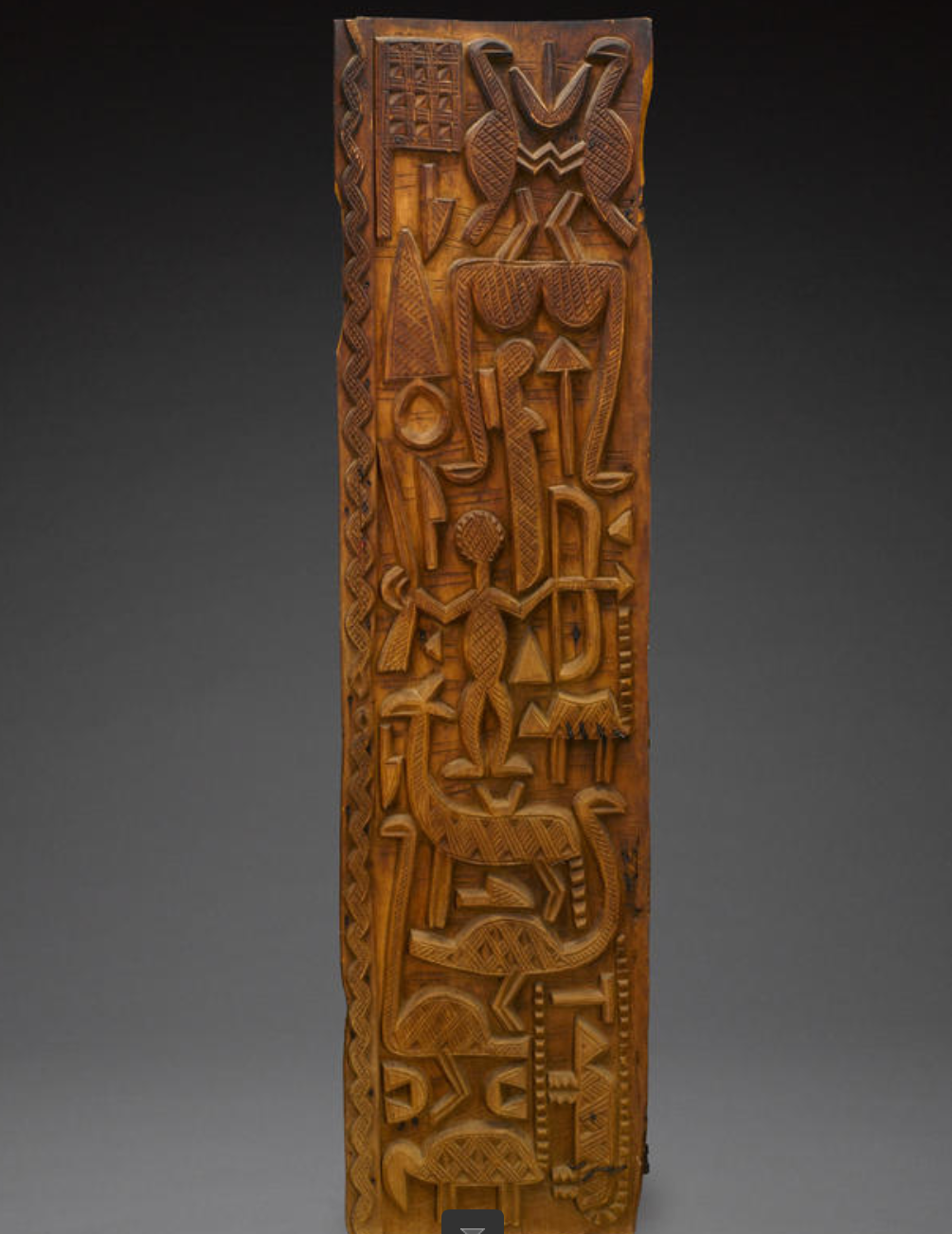
 Lot 187: An intricate Nupe Door from Nigeria, 
possibly attributable to the carver Sakiwa the Younger, sold for $3125.

  Lot 188: A gorgeous Mumuye figure from Nigeria, sold for $4375.
(profile view below)


 Lot 189 A Mambila ancestral figure from Cameroon or Nigeria, sold for $6250.

 Lot 210: A charismatic Pende Giwoyo Mask, from the DR Congo, with its comically solemn expression and grandfatherly beard, unsold (guide price $2500)

 Lot 215: A disk-shaped Mask, used in the Kidumu Society of the Tsai group 
of Teke people from the DR Congo

 Lot 218: A classic; the dynamically-featured Songye Mask, this item was photographed in 1972 in the Congo whence it was sourced(below). Sold for $3500.


Saturday, June 2, 2012

Pan Am's Flying Clippers to Liberia, c.1939


Two artifacts from the early days of Pan American Airways' arrival in West Africa. Its interesting that Monrovia was such a key link even in these first years, linking North America via the Azores, Europe via Lisbon and Dakar, South America via Brazil, and onward across Africa to Leopolidville, Belgian Congo and Johannesburg. There is also a line running across to what looks like Lagos.

Most fascinating is that the Monrovia facility was a seaplane base referred to in the schedule as "Fisherman Lake" ---its important to remember that the original Clipper Ships of Pan Am were flying boats, so even if Robertsfield was under construction, these aircraft landed on the water. I have no idea where Fisherman Lake is now-- a colloquial and bland term, almost sounding like a contemporary American suburb (how fitting for Liberia), which is now likely called something else, unless I've missed the existence of Fisherman Lake in metro Monrovia all these years.

Thursday, May 24, 2012

Highlights of the African Art Auction at Sotheby's, 11 May 2012 (2 of 2 Posts)

The second of two posts highlighting some of the gorgeous rare African art for sale on 11 May at Sotheby's in New York, including some masterpieces of several cultural groups, including a Dan container (Lot 113) and a Senufo Bird (Lot 196) from Cote D'Ivoire and a Mumuye figure (Lot 122) from Nigeria (see this 2011 post for other, similar examples of Mumuye art), as well as incredible pieces from Gabon (Lots 129 & 132) and stately Bamana (Lot 193) and Dogon (Lot 126) pieces from Mali.

Also below are some beautiful gems from less-commonly seen art traditions, including the grasslands of Cameroon (Lot 121), an amazing Zulu head-rest (Lot 178), and an elephant ivory scepter from DR Congo (Lot 194)--all three mesmerizing as abstract forms as much as fine cultural craft objects. 

The full online catalog of this auction is available at Sotheby's website. As can be seen below, several of these amazing works did not sell at all, while a few others blew pasts their estimates. 


LOT 113 DAN RITUAL CONTAINER IN SHAPE OF A RAM, IVORY COAST
ESTIMATE US$40,000-60,000 USD Lot Sold: US$68,500


CATALOGUE NOTE
Amongst the rarest objects produced by Dan artists are containers in the shape of a ram. Apart from the offered lot, only one other example is recorded in the Ethnografische Verzamelingen of Ghent University in Belgium (Yale Van Rijn archive inv. no. "0123784").
Little is known about the function of these containers. Both containers have a worn surface on top. For the Ghent example the hypothesis has been suggested that it might have served as stool or neckrest. In general, both works seem too large for neckrests. While their sizes and general shape would not be uncommon for stools (cf. one previously in the Renee and Chaim Gross Foundation, Sotheby's New York, May 15, 2009, lot 42), they seem too refined for an object of daily use. Instead, it is conceivable to locate their function in a ritual context. This hypothesis is further supported by traces of palm oil on the offered lot's surface. 


LOT 116 BAULE GONG BEATER, IVORY COAST
ESTIMATE US$5,000-7,000


LOT 119 WE (NGERE) MASK, GERE SUBGROUP, IVORY COAST
ESTIMATE US$40,000-60,000 Lot Sold: US$59,375 


CATALOGUE NOTE
The present mask, illustrated alongside the essay on Dada and Surrealism on the occasion of William Rubin's 1984 monograph "Primitivism" in 20th Century Art: Affinities of the Tribal and the Modern, is a conceptual masterpiece of Guere art. In her recent study on We and Guere masks, Marie-Noël Verger-Fèvre (2005: 111) identifies it as either war (te'e gla) or wisdom (gla kla'a) mask. According to this study (loc. cit.: 107-108), the war mask "belongs to the category of great masks by virtue of its age and of its importance in the lineage to which it belongs. This mask once played a prominent role in We lineages because it intervened in matters of tribal warfare, which was widespread before the arrival of European colonials. [...] The great mask of wisdom, gla kla'a, appears in public on rare and solemn occasions. It is present at commemorative ceremonies and the funerary rites of important individuals and high Gla dignitaries. It also appears once every decade or so, apparently for the singular purpose of exhibiting it. Whenever it appears, the full procession of masks takes place before it." 


LOT 120 NUNUMA CROCODILE MASK, BURKINA FASO
ESTIMATE US$20,000-30,000 
  
LOT 121 CAMEROON GRASSLANDS BELLOWS, CAMEROON
PROPERTY FROM THE COLLECTION OF ERIC EDWARDS, NEW YORK
ESTIMATE US$7,000-10,000 Lot Sold: US$7,500


LOT 122 MUMUYE ANCESTOR FIGURE, NIGERIA
ESTIMATE US$40,000-60,000 Lot Sold: US$110,500 


CATALOGUE NOTE
Mumuye figures represent the human form with strikingly abstract elongated shapes, ingeniously playing upon positive and negative space with openwork subtraction from a columnar whole. Kerchache (1988: 546) notes: "[Mumuye] statuary does not depict ancestors but rather incarnates tutelary spirits. Yet, statues reinforce the status and prestige of their owner who, as he holds them in his hands, has a dialogue with them and thus ensures his personal protection."
For a closely related figure see Leuzinger (1985: pl. 72b).


LOT 128 YORUBA-OWO IVORY ORNAMENT, NIGERIA
Made of African Elephant (Loxodonta africana) ivory, with Coconut shell inlay.
ESTIMATE US$100,000-150,000 Lot Sold: US$254,500 


CATALOGUE NOTE
In his discussion of the offered lot on the occasion of the exhibition Africa, The Art of a Continent at the Guggenheim Museum in New York, Ekpo Eyo (in Phillips 1995: 138) noted: "Among the Owo-Yoruba, a red costume (orufaran) is worn by the highest ranking chiefs as a priviledge granted by the king (olowo). [...] It consists of a top shirt made of imported red flannel that is scalloped to resemble the scales of an anteater or pangolin. Like the scales of a pangolin, the costume protects its wearer from harm by rendering him invulnerable. Sewn onto the scalloped shirt are a series of carved ivory ornaments (omama) depicting powerful animals such as the ram, crocodile, leopard, or horse. [...] The ram omama shown here, one of a pair (the other is in the Metropolitan Museum of Art in New York [inv. no. "1991.17.123"]), probably came from the orufaran of the chief (ojomo) of Ijebu quarter, originally located on the outskirts of Owo town proper. [...] If he inherited the costume from the first ojomo, Oladipe, then it can be dated to the last quarter of the eighteenth century. The pair of omama were very likely made by the same carver."
Drewal (in Ross 1992, p. 199) continues: "Together with the elephant, the ram is the most important totem among the Yoruba. It is a sign of the preeminent power and aggressiveness of one who tolerates no rival." 


LOT 129 FANG ARMLET MASK, GABON
FROM THE COLLECTION OF CECILLE & MICHAEL PULITZER, SANTA BARBARA
ESTIMATE US$7,000-10,000     
LOT 132 MAHONGWE RELIQUARY FIGURE, GABON
ESTIMATE US$30,000-50,000 Lot Sold: 62,500

LOT 134 KWELE ANTELOPE MASK, REPUBLIC OF CONGO
ESTIMATE US$150,000-250,000


CATALOGUE NOTE
Museum, London (Trowell and Nevermann 1968: 70); a third in the Musée Dapper, Paris (collected by Aristide Courtois before 1938, Falgayrettes-Leveau 1995: 61); a fourth in the Kulturen Museum, Lund (inv. no. "51.467.113"); and a fifth in the Etnografiscka Museum, Gothenburg (Leuzinger 1970: 241, pl. Q 9).
Kwele antelope are exceedingly rare. Several related masks are recorded in important museum collections: one in the Musée Barbier-Mueller, Geneva (inv. no. "1019-49", Schmalenbach 1988: 210, cat. 127); a second in the in the British
Hahner-Herzog (1998: text to cat. 69) notes: "The rare masks of the Kwele, a little-investigated ethnic group of northeast Gabon and the adjacent area of the Republic of Congo, are associated with the Bwete association, which maintains social order. The masks are also used in initiation rites and at the end of periods of mourning. Representing benevolent forest spirits, they have zoomorphic or anthropomorphic traits, or a combination of the two. The faces are usually painted in white kaolin earth, a pigment associated by the Kwele with light and clarity, the two essential factors in the fight against evil."
Discussing the aforementioned Barbier-Mueller mask, she continues: "The rare Kwele masks with vertically projecting horns exhibit a range of stylistic differences. Some examples, such as the one illustrated here and those in Göteborg and London depict antelopes."


LOT 136 DOGON RITUAL OBJECT, MALI
MINIATURE SCULPTURE FROM THE COLLECTION OF MARTIN AND ROBERTA LERNER
ESTIMATE US$8,000-12,000

CATALOGUE NOTE    
This fine figural-architectural sculpture features a seated figure above a tall flat form, with geometric
openwork, resembling the hilt of a knife. Several related works are known: 
see one in the Seattle Art Museum (inv. no. "67.53"); and another offered at Sotheby's Paris, December 5, 2003, lot 112. All share in common small pieces of metal which preclude the presence of a blade where it would be expected, and indeed seem too thin and broad to be handles. These metal pieces were seemingly for the addition of an unknown attachment though none with any such attachment is known. Although the specific use of this enigmatic object remains a mystery, the layered patina attests to its function within sacred ceremonies, as the refined quality of the sculpture does to its ritual importance. 


LOT 175 NGOMBE STOOL, DEMOCRATIC REPUBLIC OF THE CONGO
ESTIMATE US$8,000-12,000 Lot Sold: US$8,125 
LOT 178 ZULU NECKREST, SOUTH AFRICA
ESTIMATE US$6,000-9,000


LOT 191 BEMBE JANUS HELMET MASK FOR THE ALUNGA SOCIETY, DEMOCRATIC REPUBLIC OF THE CONGO echawokaba/echwaboga. 
ESTIMATE US$40,000-60,000 Lot Sold: US$50,000


CATALOGUE NOTE
Discussing a related mask in the Musée Barbier-Mueller, Geneva, Hahner-Herzog (1998: text to cat. 96) notes: "This mask represents a type of mask which, according to the Bembe, goes back to the Bahonga, a hunting and gathering people whose collecting of honey is said to have been done under the tutelage of this mask. With the Bembe it is called ibulu lya alunga or echwaboga, represents a bush spirit (m'ma mwitu), and belongs to the accessories of the hierarchically ordered Alunga men's association. The mask is used during acceptance ceremonies for new, usually young members, as well as in hunting rites. For public appearances the carved helmet is decorated with an elaborate headdress of feathers and porcupine (ehala) quills, and a neck fringe of fibers. The dancer is clad in a multilayered fiber costume (asamba). These impressive Alunga masks are invariably conceived in the form of cylindrical helmets with two, as it were, Janus faces, whose black rhombic or cross-shaped eyes with protruding pupils are set in large oval hollows painted white. Due to these striking facial features the masks have been interpreted as representing owls, with which the masqueraders in fact occasionally identify. In addition, the two faces are intended to invoke the all-seeing nature of the mask spirit, a capacity which enables him to reconcile the opposing forces of nature, such as male/female or day/night." 


LOT 193 BAMANA OR MANINKA HELMET MASK, MALI
PROPERTY FROM THE COLLECTION OF ZAFRIRA AND ITZHAK SHOHER, TEL AVIV
ESTIMATE US$25,000-35,000 Lot Sold: US$26,875 


CATALOGUE NOTE
(1995: 60). Another closely related mask, also previously owned by the Carlebachs, is in the Menil Collection in Houston (inv. no. "X 0039"). Describing that example, Malé (in Van Dyke 2008: 62) notes: "In the context of initiation, its role is evoked by the phrase ba kara misi; according to Youssouf Tata Cissé, quoted in Tal Tamari (2001: 101- 102), 'this designation is composed of ba (mother, basis) and kara (perfect circle, creation spirit, divine spirit); one could translate this expression as foundational circles symbolizing the divine spirit [...]. Accordingly, the various elements of the misikun mask seek this formal perfection."
For a closely related domed, horned, faceted helmet mask in the Musée Dapper, Paris, see Falgayrettes-Leveau 
He continues: "The misikun mask is attached to a wearable marionette in an ensemble worn by two performers. [...] When it appears on the scene, the misiba [cow] walks around the area with a serene, graceful gait, and then stops in the middle of the village. During this promenade the shepherd raises and lowers the stick like a rider encouraging his steed. When the marionette stops moving, the young women intone the popular song "Misiba", composed in honor of generous men. The misiba symbolizes generosity among the Bamana and Maninka. [...] The performance teaches the duty of protecting those who are generous. Whereas the mask represents simply a bovid, the marionette evokes a more specific contribution of ploughing cattle to the local agriculture production; through other songs, tribute is paid to their labor." 

LOT 194 LEGA IVORY SCEPTER, DEM. REPUBLIC OF THE CONGO
African Elephant (Loxodonta africana) ivory. 
PROPERTY FROM THE COLLECTION OF ZAFRIRA AND ITZHAK SHOHER, TEL AVIV
ESTIMATE US$6,000-9,000
   
LOT 196 SENUFO BIRD STATUE, IVORY COAST
PROPERTY FROM THE COLLECTION OF ZAFRIRA AND ITZHAK SHOHER, TEL AVIV
ESTIMATE US$70,000-100,000 Lot Sold: US$86,500 


CATALOGUE NOTE
Koulotiolo, creator of the world, a distant and inaccessible diety. On the other hand, the mother of the village, Katieleo, regenerates the world and redeems humankind through the initiation rites of the poro. [...] A male villager who has not been initiated will be excluded from the village and will lose his rights as a citizen."
According to Kerchache (1988: 512) for the Senufo, the poro association "[...] is the pillar of communal life. Responsible for the initiation and training of the young boys, it is aimed at shaping an accomplished, social man who is integrated into the collective; it aids his entry into public responsibilities. [...] The Senufo believe in a god, 
Garrard (in Phillips 1996: 457) notes: "In former times many of the men's secret Poro societies in the Senufo region owned a large standing sculpture of a bird. This statue, kept in the sacred forest, was used in the rites for the admission of initiates to the final phase of training. It generally had a hollowed base, which permitted it to be carried on the head of an initiate. Some examples also have holes in the wings, through which cords were passed to steady the bird when carried. [...] Older Senufo [...] usually name it as sejen or fijen [...] a term that simply means 'the bird'. The significance of this bird is indicated more clearly by two other names. It is sometimes called kasingele, 'the first ancestor', which may refer either to the mythological founder of the human race or to the ancestral founder of the sacred forest. Alternatively, it is named poropia nong, which means literally 'mother of the Poro child'. The statue is thus a primary symbol of the Poro leadership, indicating the authority of its elders."
The morphology of these rare statues references both male and female characteristics, with the swollen, pregnant belly, and the elongated phallic beak. A related figure is in the Metropolitan Museum of Art, New York (inv. no. "1978.412.382"). 
LOT 197 SALAMPASU MASK, DEMOCRATIC REPUBLIC OF THE CONGO
PROPERTY FROM THE COLLECTION OF ZAFRIRA AND ITZHAK SHOHER, TEL AVIV
ESTIMATE US$25,000-35,000

 LOT 198 LEGA FIGURE, DEMOCRATIC REPUBLIC OF THE CONGO
PROPERTY FROM THE COLLECTION OF ZAFRIRA AND ITZHAK SHOHER, TEL AVIV
ESTIMATE US$10,000-15,000 Lot Sold: US$25,000

Thursday, May 17, 2012

Paula Scher's Map of Africa


At the other end of cartographic history from the previous post's artifact sits this contemporary specimen from world-famous graphic designer Paula Scher of the Pentagram Group. In its own way nearly as abstract as the chart from 1570, with fanciful interpretations of the shapes of many of the countries, especially Cameroon, Benin, Mozambique and several others. 

The map's defining feature is overwhelming bustle of twisting place names that fan out across the entire canvas. Country names and capital cities are most prominent, but each space on land and ocean is filled with the chalky block type of cities and other features near to their true location. 

"Liberia" is in white and upside-down from the reader as the Guinea Coast turns northwesterly. "Monrovia" is nearly more prominent in black, delimited in a white box. Between the two sits the large, bending "Grain Coast" crammed in with a dozen other town names: Harbel, Mount Barclay, Buchanan, Edina, Hartford, Greenville, Marshall, Brewerville, Tubmanburg, Robertsport. Settler communities, all. Back on the land, names of a few county towns can barely be deciphered in tiny, thin letters-- only Zwedru is large enough to read from afar. 

Monday, June 20, 2011

Literary Break: The War Came

Two excerpts from two excellent, recently-published books.


Sinkor, Monrovia, July 1990

"We scattered. We all ran between the houses, everyone fleeing in different directions. Some were getting shot down. Others were escaping. I went inside an abandoned building. I climbed into the eaves of the roof. There was a little platform where the roof meets the wall. I saw that there were three other men who had done exactly the same. We could not be seen from below. We lay there in absolute silence, not daring to say anything to one another...


We stayed there, the four of us, for a long time, nobody speaking in more than a whisper. It grew dark. The new morning came. We were still lying there.


At about eight o'clock, the other two decided to climb down to the ground…Augustus and I deliberated. We did not think it was safe. Throughout the night we had heard soldiers, gunfire, shouting. Early in the morning we had heard them again. We stayed where we were.


So the two went down and left, and just a few minutes later, we heard shouting, then pleading, then gunshots. And then silence; we were sure they were dead. We heard men cursing in Krahn.


And so we just stayed. On and on and on. Augustus and I. In the end, we stayed in those eaves three nights. At no point did it seem safe to come down. The gunfire was always too near. But on the third morning, we could not take it any more. We had both dehydrated. We had both become sick.


So, we came down. Augustus was our point guy. He was checking around to see where the soldiers were. We had gotten a block, maybe just a block from the building where we had hidden, when the soldiers saw Augustus, and we both ran.


I ran into a house. I was very, very fortunate. It was one of those houses you call a "straight" : you know those buildings where the front door leads straight to the back down a passage. I ran through the front door and closed it, through the back door and closed it. They thought I was in the house, they searched it, but I was still running. Ideas were just flowing to me: do this, do that, ideas were just flowing to me. I threw myself in the long grass. Lie down.


I heard people scream in the house. They were beating them. Then I heard my friend Augustus. He was crying: "Don't kill me! Don't kill me!" They said: Where's the other rebel? Where's the other rebel?" "I don't know."


And then Ba Ba! Ba Ba!


I didn't hear his voice again."


--Little Liberia, Jonny Steinberg. pp.86-88


----+++===+++==+==+++====+++----


Kilungutwe, Congo, June 2000


The soldiers herded the traders and the locals into a small house below the road, a sturdy cement structure about twenty feet by forty feet, with blue wooden doors and windows and a corrugated iron roof. The sixty people stood packed like sardines in the small house. The sun went down, leaving the room in darkness except for some cracks in the window, through which they could see a fire that the soldiers had lit outside. It was hot and humid, and the air was filled with the sound of muttering and breathing. Several people prayed out loud. A baby's cry turned into a persistent wail, until finally her mother began sobbing and said that her baby was about to suffocate.


"We called the soldiers outside and asked them to have pity on the newborn," Michel told me.

Without asking any questions and as if one cue,t he soldiers let the woman out. Suddenly, the prisoners heard screams coming from outside, first from both mother and child, then just from the child, then silence…All of a sudden, the room was full of people crying and praying to God in French, Swahili, and whatever other language came to their lips.


Michel was in the back of the room, where he was crushed against a wall as the others tried to get as far as possible from the door, through which the soldiers came and grabbed people one by one. As the people thin ed out, he was bale to get a better look at his surroundings in the half-light. He saw that one of the thin ceiling boards was loose. He hastily climbed up and bumped into several other people lying in the small space between the ceiling and the roof. It was even hotter and danker here, and he could feel the bodies of his neighbors trembling with fear. He was close to fainting and felt like vomiting.


After a while, the screams faded below them and they could hear soldiers shuffling around the sound of bodies being moved outside. Someone was counting, then a voice in Kinyarwanda said:

"How many did we put in the house? Did you count?"

"Yes there were at least sixty."

"Are you sure? Where did the rest of them go?"

"I'll check again."

Feet began to scrape the floor below them and then someone piked the ceiling boards.

"We! You up there! How many are there?" Michel's neighbors' trembling increased until he was afraid they would begin to rattle the ceiling boards. "I can hear you up there! How many are you?"


After poking for a while, the soldier went outside. They hear the men muttering with each other, and then several came back into the room. Suddenly, an iron spear tip burst through a ceiling board not far from where Michel was lying. The boards were made out of flimsy plywood and the spear pierced it easily. The next jab hit Michel's neighbor in the leg, who cried out.


"Come down now, or we will get out guns! Just tell us how many you are, and then come down!"

Several more spear jabs came through the roof. Three of Michel's fellow prisoners climbed down from the hideout. Michel turned to a woman who was lying next to him.


"We must pray now, " He told her. "we are going to die." She started crying.

****

"When I looked to my side, I saw a woman in white lying next to me," Michel finally said. "I hadn't seen here before, and It bought it was strange that she was wearing all white. I turned to the woman lying on my other side, who was sobbing, and asker her, 'Do you see her? The woman in white?' It was very strange to see a woman dressed all in white. It was ver dusty then; it was the dry season. White clothes were maybe things you wear to church or to a baptism. And she seemed--she seemed to be glowing. My neighbor shook her heard and continued sobbing. Then the woman in white said--her voice didn't seem to be coming from her mouth, but from inside my head-- she said, 'Stand up! Stand up now!" And I gathered my strength and just stood up. The roof was very low-- you couldn't even kneel there-- but as a stood up, a sheet of roofing came undone from its blots, and I could see the night sky. Thee was no moon that night, I remember. I stood up and slide down the roof. 'Someone's getting away!' one of the soldiers cried out, and they opened fire. I could hear the bullets whistling by me and going into the ceiling where I had been lying with the others. But I wasn't hurt. I jumped down from the roof and began running into the bush that surrounded the house. My legs were moving on their own." Michel looked at me. 'That angel saved me. God saved me."


He ran through the palm trees and the cassava fields that surrounded the village as shots rang out behind him. He kept on running until he found the hut of a relative of his on a hill several miles away. Together, they watched the village burn in the valley below them.


--Dancing In the Glory of Monsters, by Jason K. Stearns, pp. 258-260

Thursday, June 9, 2011

Literary Break: Dancing in the Glory of Monsters

Kisangani, 2006. Image courtesy Flickr user Julien Harneis.

Last week I finished reading Jason K. Stearn's incredible book, Dancing in the Glory of Monsters: The Collapse of the Congo and the Great War of Africa. In less than 400 pages, this awesome volume gives a sweeping yet concise, multifaceted yet lucid history of the wars in the Congo, and their causes, characters, and consequences.

The book details several locations, especially the Great Lakes region in the east, and the capital, Kinshasa, in the far west. But the events, like the Congo River itself, turns decisively at Kisangani, the jungle metropolis of Stanley Falls, which in many ways links the two halves of the huge country.

Stearn provides a description of the city that is romantic and majestic, yet hopeless and horrifying.

While the book is hugely important in understanding the events of the Congo's complex conflicts, many of its pages take the time to describe not just the facts and events of the country, but its places and its people. Highly recommended reading.

Interspersed in the passages below are borrowed images of Kisangani/Stanleyville, as well as the fish weirs of the Wagenia.

======+++++=====+++++=====+++++======


Kisangani, c.1970


In May 1999, The city of Kisangani, later dubbed the City of Martyrs, fell victim to the worst bout of urban warfare the Congolese war had ever seen. The battle had dramatic consequences: it spelled the end of the Rwandan-Ugandan alliance and brought to the fore the plunder of the country's riches.


The city's reputation had not always been so bleak. The town of a million people was located in the middle of the country at a bend in the Congo River. In the 1960s, it had been an attractive city laid out along grand evens lined with jacaranda and mango trees. It is clear that the Belgians had had big plans for the jungle city: Italianate turrets and futuristic, Art Deco architecture; streets named after Chopin, Beethoven, and Belgian royalty; and a city divided by the great river into "Rive Droite" and "Rive Gauche" reminiscent of Paris.


Map of Kisangani, 1997. From the University of Texas Libraries Collection
Kisangani formed a trade hub with the eastern provinces by road and with Kinshasa by river. Roads branched out into the jungles to the north, where there were large ranches and coffee plantations, and merchants brought huge bags of rich palm oil down the river in dugout canoes. However, Mobutu's kleptocracy had reversed the flow of time in the town, as buildings crumbled and the jungle reclaimed land.

Building in Kisangani, built in 1925.
Image courtesy Panoramio user Jambo Sana, 2009.

The war had further sapped the life out of Kisangani. The whitewash had faded from the Art Deco facades, the pavement was cracked and overgrown with grass, and most shops were boarded up and empty. River traffic had all but ceased, as no boats were allowed up the river from Kinshasa into rebel-held territory. With no fuel or spare parts available, the only motorized traffic on the streets were a few dozen vehicles belonging to humanitarian organizations. The only means of leaving town--unless you wanted to trek on foot for a week through the forest--was by plane, so all luxury goods had the cost of an air ticket slapped on to their price tag.


Kisangani, 2008.


The isolation had its impact on the locals. Almost 10 percent of children were severely malnourished, retarding their physical and mental development and making them prone to disease. The inhabitants now had to rely on the tens of thousands of toleka ("let's go" in Lingala), the bicycle taxis with cushions bolted onto their baggage racks for passengers. Except for the parish and several hotels, which had diesel-run generators that sometimes worked, the city was left in the dark after sunset. Kerosene lamps and candles flickered in bars at the roadside.


Stanleyville, Belgian Congo, 1957

Kisangani became the graveyard of Rwandan and Ugandan reputations, where the two countries' lofty rhetoric gave way to another, more tawdry reality.


---above passages from pp.235-6
=======+++++=====+++++=====+++++=====+++++======


Other than finger-wagging by diplomats, there were few consequences for the occupying forces. A joint investigation by the Rwandan and Ugandan army commanders arrived in town and agreed on taking steps to prevent further fighting, but little was done…They banned toleka riders--around 2,000 in the whole town-- from working, accusing them of complicity with Wamba and the Ugandans. They even dismantled the famous scaffolding set up by the Wagenia fishermen in the Congo River; they said the fishermen had helped guide the Ugandans to safety during the fighting. The scaffolding, imposing thirty-foot-tall pieces of timber lashed together and anchored in the rapids, has been a tourist attraction in Kisangani since the first Belgian colonial postcards were made. The Rwandans certainly did not know how to make themselves loved.


--above passage from p.246

Zaïrien postage stamp, c.1973.
Tweets by @moved2monrovia