Showing posts with label Clouds. Show all posts

Monday, April 7, 2014

Bats

Gabriele Asare, posted on YouTube

Like many other West African cities, Monrovia is beset with large colonies of bats, when not hanging over the city from the ruins of stately Cotton trees, they swarm the skies like a plague of locusts. There are about five or so such trees in central Monrovia, broad and ancient, that rise above the rooflines of the oldest parts of town.


Denuded and presumably dead, they are enlivened by the diabolical presence of hundreds and thousands of flying mammals. Once, while driving up Snapper Hill to the Ducor Hotel, I passed one of these great dead oaks, its countless inhabitants clinging under each huge limb like dried fruit, while a few diurnal specimens flittered about. A single bat, ready for a nap, landed upside-down on a branch. It was the straw that broke the camel's back in real life: the weight of that one small flying-mouse was too much; the great old bough came crashing down as if struck by lightning: thunder clap and all. Dazed creatures, panicked by the pruning and blinded by the afternoon sun, flew chaotically in all directions: some directly into the ground, some into a chain-link fence where they became entangled. Within moments, a price had been put on a bar, and I am told by a friend who lived nearby that bat soup was the weekly special.


Even absent such a spectacular event, these tree-colonies are remarkable scenes though they are in many ways unsettling. The nearest image to the hive of half-frenetic, half-febrile activity would be vultures on a carcass, yet a carcass would never have so many ravenous attackers. When frenzy hits these nocturnal clans, the sky darkens a shade, the already-brief evening hour hastily blotted out with each small pair of slightly-translucent stretched-skin wings. The Wingéd Monkeys, lifting off to the shrill commands of the Wicked Witch of the West, come to mind.


This threatening aspect has grown with the swelling of the Ebola panic which has swept into town and onto the headlines of the newspapers. A popular fact shared among acquaintances is that fruit bats are the carriers of the virus, and Guinea has gone so far as to ban the eating of bats. So it is not too far from the mind to think of the immune risk when the sky darkens with the flittering, furry beasts, carrying death from afar. A report from Abidjan, from earlier in the month, chronicled just this wariness, of wrath of sky-borne couriers of the fever. Even before all the attention given to their presence due to the virus, they were seen as pests to eradicated. Both the U.S. Embassy and at times the local government have chopped down trees hosting bats.


Laurent Guilard posted in the Daily Motion

Despite lending themselves so excellently to be wicked omens of doom, the chattering communities of bats are an amazing site in the middle of the the concrete jungles of urban West Africa. I hope they remain overhead.

Tuesday, February 11, 2014

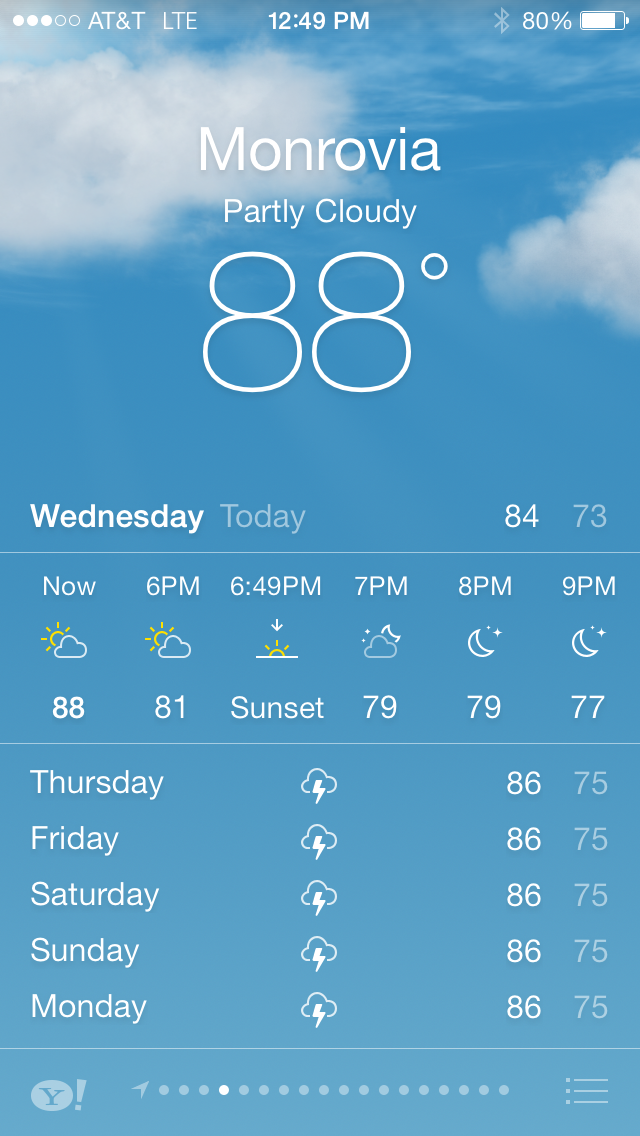
The Weather Forecast for Monrovia is: Yes


I don't pay much attention to the weather forecasts for Monrovia. The climate veers between Sauna and Steam Room for most of the year; the only relevant information to understand is that it is oppressively hot and humid, and will either remain that way for weeks (dry season) or a violent 42-hour downpour will start in a few hours (wet season). 

Despite only enjoy a few hours of mild weather per year, I do keep Monrovia as one of my cities on my weather app, more to just root for the home team than to consult for planning purposes. I've noticed, however, that throughout the year the weather app remains remarkably the same, and 90% of days forecast thunderstorms, as seen in the above screenshot. 

I don’t know what the deal with this is; is there is just poor radar and data-gathering (likely) or the computer models that determine which symbol wins out which day constantly put the possibility of a thunderstorm in such a high-humidity environment as great enough that the lightening symbol hits the jackpot day after day. Nonetheless, there are not thunderstorms here every day, especially in February, so even as minimally useful as a weather forecast for Monrovia is, the smartphone weather apps aren’t very enlightening in their present functionality. 

Monday, September 17, 2012

Dampened Liberia

Monrovia is extraordinarily rainy, and this year's rains have been extraordinary. I was told by a professional in rain-water collection that its rained almost twice as much as usual this year. It's the second half of September, and yet the rainy season doesn't seem to be slowing down. It's still raining. One week in August, it rained more or less continuously from Sunday afternoon to Thursday evening, cycling from drizzles to downpours. Streets fill with water. The clouds are low and the light is dim-- as depressing as a Scandinavian winter.

I wrote about the rainy season last August, including the phenomenon of motorbike guys drying off in the wall-sized exhaust vents of huge generators, who are almost always designed to spew their filthy smog out into the street. The very same observation of the very same half-clothed huddle was mentioned in a recent Baobab column about Monrovia's rainy season, which is copied below.


A sudden stiff wind offers momentary respite from Monrovia’s punishing humidity, but it is only the harbinger of worse to come in Liberia’s capital. As huge rain-drops begin to spatter the ground, people scarper for cover. Motorcycle-taxi drivers abandon their bikes as the heavy sky empties its load.In the month of July alone, Monrovia sees almost double the rainfall that London does in a year. It is the wettest capital city in the world, fighting back the floods from May to November. During this period, those who drive to work in UN or Liberian government cars complain of patchy internet service and the increasingly pot-holed roads. But as ever, it is Liberia’s poor majority who really bear the brunt.Monrovia is a tropical, seaboard city with many communities built on Mangrove swamp. Mosquitoes multiply as the water level rises. On higher ground, wells overflow with the run-off from the city’s open sewers. Water-borne bacteria thrive; typhoid and dysentery spread. Worse still, the capital’s controversial mayor, Mary Broh, has chosen this rainy season to demolish many of the city’s squatter settlements. With this looming threat, new roofing seems a poor investment for Monrovians...Over the past fortnight, at the height of the rainy season, the main roads to many regional capitals have been impassable. With key arteries blocked, the prices of basic items spiral. In Voinjama, in northern Lofa County, a gallon of petrol can fetch almost $9. In Sinoe County in the south east, a single egg, at the end of its long journey from India, sells for more than 50 cents.Nine years after the end of the civil war, the lack of decent roads to places like Sinoe County seems a damning indictment of the government’s approach to rural development under President Ellen Johnson Sirleaf. Sinoe, after all, has attracted large international concessions agreements for Palm oil, gold and timber. Many locals, who were told the presence of these companies would improve their lives, now blame the swift degeneration of the roads on the weight of foreign firms’ lorries laden with the Liberia’s bounty.Back in Monrovia, smiles return as the rain finally stops. In the prosperous Mamba Point area, near-naked motorcycle-taxi drivers dry themselves by the heat of a big generator, still the main source of electricity for those with sufficient means. President Johnson Sirleaf has promised that work will finally begin this year to restore the country's huge Mount Coffee hydro-electric plant, which has been left derelict since 1990. Time will tell if Liberia's water curse can be turned into a blessing.


Not only does it give some description of the incredible wetness, but its astonishing effects, in every meaning of the word dampening Liberia: making most of the country's roadways impassible to vehicles, virtually shutting down the interior trade networks of the nation.

Added to this the extremely common yet no less bizarrely extreme aversion of many Monrovians to getting wet. People miss appointments, fail to show up for work, with the endless excuse, the rain. As if rain was actually acid to the skin, yet many Monrovians do not own any type of raincoat.

When the rain starts, the city slows. Not as you might expect in many cities, where inclement weather induces caution in motorists and causes traffic: quite the opposite, the chaotic roads of the city are devoid of pedestrians, waiting taxi passengers, and motorbikes. Traffic streams along the boulevard smoothly: more than one friend has told me he loves it when it rains because it is so easy to get from one part of the city to the other (especially now that traffic has gotten so bad). I often wonder, with an economy growing at over 8% per year, how much quicker it might be developing if it had better roads and more plentiful, less expensive utilities. I also wonder, in weeks like these, how much of Liberia's GDP is lopped off due to the rains, and the lack of preparation for it.

Thursday, April 26, 2012

The Verdict

There were no disturbances on the street in Monrovia today, as some had feared, others had predicted, and even a few had hoped for.

There was a small crowd around the Daily Talk on Tubman Boulevard, where a crowd of young Taylor-sympathizers brought some clever signs, some alarming t-shirts, and the inevitable shrine to Papay Ghankay himself in the form of an oversized poster:


Just after the verdict was read a continent away, really immediately coinciding with it, a rainbow formed a halo around the sun. This lasted about an hour, perhaps more. I've now read international journalists' reporting positive and negative divinations of this rare astrological phenomenon.


Sunday, April 15, 2012

April is the Cruelest Month

The above photo is from mid-April 1979. The corner of Broad and Randall Streets, the "1st and Main" of Monrovia, which is still today the site of the Palm Hotel and is down the street from the KLM desk, but no longer boasts a swish Swissair ticket office or Panasonic showroom. The city of that morning looks modern, cosmopolitan, and affluent, but on closer inspection, a disorder is evident.

It is one of the first days after the Rice Riots, perhaps even the very next morning. The Swissair agent's glass windows are smashed away, and the debris of chaos is visible on the otherwise immaculate pavement. At least forty Liberians are dead, the first casualties in a violence which would crescendo into a great massacre of hundreds of thousands.

While travel agents would sweep up the lobbies of their plush storefronts and enjoy a few more years representing European airlines, and the Lebanese Hi-Fi salons would still find customers for the latest American, European, and Japanese electronics, the golden days of Monrovia's prosperity were coming to an end. Later that year, in June, President Tolbert would open the Hotel Africa and Unity Conference Center, and for a brief while it would seem that Monrovia was still the capital of Africa, and Liberia was still a leader among its nations.

But by the next April, Tolbert would be dead in his bedroom, burial place unknown. His cabinet, including his family members, would be tied up and shot on the beach, or never be seen again.

That would be a full decade and half before the hell of April 6th, 1996, which drowned Monrovia in an acid bath of looting, destruction, mayhem and murder, and announced the arrival of the new leader, Charles Taylor.

It would be another seven years before the chaos of April 2003, when World War III rained down on destitute, desolate Monrovia in the form of un-aimed rockets, blind grenade landings, and the deadly whistle of AK bullets whipping through the streets.

April has come to Monrovia again, full of dates which are remembered by mourning if they are thought of at all. The clouds are changing. The waves, so crisp and evenly paced in previous months, crash haphazardly on shore. The bright sand repels the tidal forces, sometimes sending them back to crash against the next onslaught, a spectacular sight that forebodes of dangerous currents for swimmers. The seasons are changing; the skies begin to dim with cloud cover, soon to darken with rain.

Wednesday, April 11, 2012

A Morning Crocodile Cloud

I woke up this morning to an immense crocodile-snouted cloud rising with the sun over the ocean. I was startled, but take it as a good sign.

Friday, February 10, 2012

The Mid-Dries

Suffering Sinkor under a Saharan Sky.

The New Year in Monrovia is usually one of this city's most pleasant periods: for about four to six weeks, from early January to mid-February, the pepper coast experiences "the mid-Dries," when the humidity drops, the breeze picks up, and the air is neither thick with moisture nor bludgeoning with the blasting force of the sun.

This period coincides with the appearance of the Harmattan, a high-level weather pattern that brings Saharan sand south to the coast, from Nigeria to Cape Verde, and often cloaks coastal cities from Accra to Conkary in a low-visibility haze.

North America hardly has any named winds, so part of the romance of many ex-patriate West Africans' experience is constantly bemoan the Harmattan (whether their pronunciation is more Manhattan or closer to Benneton is apparently a matter of choice), even when it is bringing welcome relief from the scorching sun of the dry season rather than the noxious choke which cause such fear for the northern Sahara's sandy onslaughts of similar appellation.

The Harmattan Horizon: the ocean's edge disappears.

I am no meteorologist, so I'm in no position to describe these phenomena nor link them together, but while this year's mid-dry period has been welcomely temperate, the dust storms have been remarkably overbearing.

Learn 2 Speak Liberian:

Fog, Haze, Dust Storm = "Dew"

Liberians seem to limit their naming and observing of this phenomenon to their typically tangential word-usage: repurposing the word "dew" to apply to a high-altitude dust storm, which may in fact contain moisture but is more substantially sand than water. It is true that the low-level cover does look foggy: one morning this month the Executive Mansion was hidden behind a shiny ground cloud, unseeable from the street.

Locals also don't respond kindly to the drop in temperature: winter coats, caps and hoods are donned; when in other seasons it is mercilessly stuffy inside their ventless homes and bedrooms, Monrovians complain of suffering from "colds" and other illnesses, shivering as the weather approximates an Arizona evening for a few days.

Congo Town cloaked in haze.

This year, the dust storms have been the talk of the town, Roberts International Airport was completely shut down (flights in Ghana and elsewhere were also cancelled). Reportedly, some Delta flights nearly reached Liberian airspace before turning around to return to Accra. While the outside air temperature never dropped below 70F, The New Dawn newspaper screeched of "thick dew and severe cold" causing chaos at the country's principal international gateway (emphasis added):

A rather abrupt change in the weather condition here in the last few days characterized by thick dew and severe cold is said to be impeding smooth landing of commercial aircrafts at the country's main airport - the Roberts International Airport or RIA in Margibi County, leading to the daily loss of revenue.

Most airlines were unable to land here on Wednesday due to dew falling, which has obstructed visibility.

Sources at the RIA on condition of anonymity hinted the New Dawn Liberia that due to the natural causes (dew falling); aircrafts did not land at the airport on Wednesday, but at least one was expected to have landed Thursday night, February 9th.

Notwithstanding, it is yet to be confirmed by relevant authorities claims that a special flight landed at the RIA yesterday, while another flight was expected last night.

Efforts to contact the financial and technical sections at the airport to ascertain the level of financial losses being sustained as a result of the bad weather have not materialized.

Prior to the escalation of global climate change, which no doubt is affecting Liberia today, dew usually fell in January during morning hours characterized by dried air.

Liberia had dense forests, but experts have warned persistently that shifting cultivation and deforestation (by farmers and loggers) could endanger the country's rich forests. Local farmers here usually do not replace trees by replanting, thus leaving the country vulnerable to climatic challenges.

Meanwhile, in town, trees, cars and buildings were coated in a fine dust; the mid-dries made the mid-rises of Central Monrovia became mere outlines in the haze. The normally-overpowering sun became only a single low-watt bulb covered in cobwebs. While this might describe a stifling, suffering experience, the air stirred with a small breeze and the thermometers dropped enough to give the air-conditioners a much-needed break, and window-screens checked to be left open in the evenings.

Thursday, September 29, 2011

Leaving & Returning

As they say in Liberia, "I'm coming." Which could mean, of course (as I point out to Liberians when they tell me they are coming), that the person will show up in a few minutes, a few hours, or basically what in the United States we call never.

I hadn't planned to take such a long hiatus from this blog, but the very reason for my return to Liberia, the opportunity which brought me back, has since proven quite demanding. So, August stretched into October (by way of September, as it does).

I am not complaining, just explaining. I am sure I wasn't too sorely missed, anyway. But there is a particular, pit-of-the-stomach, wide-eyed, shock-down-the-spine anxiety that comes with the realization that its been yet one more week without blogging, and that it will be just that much harder to get back in the habit. So to all those who read this blog, but especially to myself, I apologize for my procrastination.

It wasn't as though I was idle. My return to Liberia was rather sudden, as a fantastic and new reason to be ex-patriated came about in a very joyful and serendipitous recruitment for a fresh role. Yet the logistical circumstances were, as soon as I could get on an airplane. This sort of scenario is both the realization of a childhood fantasy of world travel, but increasingly a bruising body-blow to my adult life, as I am forced separate myself from home and family to continue my career in Liberia.

This is not the first time, in fact, that I've more or less gotten a last-minute call, and next it seems I am driving to the airport, and not touched the ground again until greeted by the humidity and woodsmoke of a West African airport tarmac. In fact, this is usually how I have come to spend a stretch of time here.

This has meant the sudden shifts of culture shock, the quick termination of the mundane but orienting routines. No last burrito at Chipotle, nor Iced Coffee at Starbucks, no last livestream the week's Daily Show episodes. It also meant goodbyes so immediate that the pain that comes with the end of an embrace were only felt when the plane had leveled off above the cloud line.

The excitement of the opportunity of my experiences in Liberia don't temper the difficulty of leaving family behind. There is that small thought, that noticeable component of consideration, that it is not just the challenge of being absent from others, but the also real presence of danger, that is makes this particular separation so hard. Working in a 21st century African city may be a week-to-week schedule of surfing and sushi, but it is at the same time an historically harrowing territory, from slave-trading to small-boy units, a reputation which prevents so many foreigners from ever coming here.

=+==+===+==+=

The night before my first departure for West Africa, years ago now, before I had ever been on the continent at all, I had a dream so vivid that I can recall its details better than most waking memories.

I am treading water in the middle of a slow river, or long lagoon. The banks are bordered with palms, thick jungle behind them: it is the tropics.

I look down below me, in the dark water, my chin to my chest. A huge shape, horrible, rushes up, the space beneath my body becomes dark green, then lighter, the outline more defined even as it moves with great speed, growing enormous.

It is a crocodile, aiming at me with tremendous force, its leviathan mouth red, spiked with white.

Somehow, at a precise moment, I whip my leg back and execute a powerful kick to the snout of the animal. Its jaw snaps shut, empty. It darts down, plunges back into the water.

It is gone. I have defended myself. I am safe for the moment, but I know now that it could return, and there could be others.

Perhaps I was playing into stereotypes, but I couldn't help think that it was unusual to have such a lucid vision, featuring an African animal, the night before I fulfilled my life-long dream of traveling to Africa.

I spent most of the next two days on airplane, and arrived two nights later in Ghana. I asked some new acquaintances about any particular African symbolism of crocodiles. This was met with a mix of reluctance to discuss juju tales, either because of my foreignness, or due to a preference for Christianity. Vague responses didn't help explain whether such a dream had any meaning for me to understand.

I left for Liberia a few days later. My dream was not so much on my mind as it had been a few days before, but I was still feeling strongly like I was supposed to gain an understanding of something from it.

Therefore, what appeared out of the airplane window as I flew from Accra to Robertsfield that stormy, early dry season evening, was all the more incredible. The clouds' formation might have been remarkable for its finely articulated apparition alone, but given my haunting dream a few nights before, I was stunned to watch a formation appear in front of me.


I am not asking readers to play make-believe games. However, I hope most can watch the above video and see that the storm cloud covering the setting sun has, for a sustained duration of over two minutes, formed a gigantic crocodile's head staring straight at the viewer, with distinct skeletal eye sockets, nostrils, and, as the clip plays on, a teeth-baring snarl, with awesome bolts of lighting electrifying around its face and eyes, within its skull and snout, at one point zigzagging down the jaw line. I hope for the purposes of this post that most find that to be at least acceptable as a possible interpretation of that meteorological arrangement.

The point of me relaying all this is not to debate what is or isn't there to be seen, anyway. What I felt at the time was a very clear sense that I was supposed to be seeing it. I half expected for the shaky video that I shot to later play back with no evidence of any animal form, as if I had seen a ghost and pointlessly tried to record it.

But this was not a hesitant, brief apparition: its appearance (and reappearance since), was sustained, evident, and recordable. During my next flight to Liberia, again the sky began filling with the same distinct profile of a crocodile's head, here and there in the blankets of clouds. Some facing, some alongside, some with their backed turned. The main elements were always an elongated snout, often with bulbous nostrils at one end, and a face marked by a twin pair of spherical, proud eye sockets. Whether or not these images appear suitably reptilian to others, I unmistakably felt each time that I was supposed to be noticing them.


But if I felt sure that I was supposed to being seeing this, Why? To know that going to Africa is dangerous? In what way? For every foreigner, or particular to me? Liberia may offer more likely encounters with both malaria and machete than Massachusetts, but I am usually one to argue that someone is more likely to experience crime in Manhattan than in Monrovia, and, if anything, discredit the intrepid reputation that Americans often assign to those with extended periods of residence in sub-Saharan Africa.


These images continued to reappear in the clouds each time I flew to Liberia, and so I became more used to them. It began to seem like it wasn't so much the personal-harm, life-or-death type of danger that these shades warned of. Its hard to articulate what they did instead convey, but it seemed to me be a more prudent offer of caution: a think-before-you-act, look-before-you-step variety of wisdom.


This curious, fanciful thinking had all faded from my mind after I left Liberia last year. Back in the United States and Europe, my set return became more and more uncertain the longer I stayed out of the country. Considerations of career were much more frequent than thoughts of crocodiles. Anyway, I never noticed any clouds that had that particular, recognizable shape.

=+==+===+==+=

Earlier this year, a call came. A meeting was arranged, followed by an offer. I was really going back, and it had to be as soon as possible. It was a relief, but a shock, a cause for celebration but also the return of a certain, familiar anxiety and sorrow. Looking forward to a great new opportunity was also a sad occasion.

After I had accepted the offer, I drove out to a pier overlooking Boston Harbor, and looked out on the late spring clouds stretching over a waveless ocean. There, in the distance by the horizon, was a crocodile's head. I watched it hold its form in those minutes, the beast a companion in that moment that my mind began to process a mixture of emotions: happy to be returning, but sad to be leaving.


A few days later, I had left home. I passed through Europe on the way back to Africa, to enjoy the company of family before a long separation. An itinerary that covered Amsterdam, Bavaria, and Paris might seem a world away from Liberia, which it of course is in so many ways.

I was therefore slightly startled when, on my first day in Amsterdam, while paused on a bridge over the Keizergracht on Leidsestraat, I realized that I was nearly leaning up against a crocodile, facing me, lipped curled in a snarl:


There was no question in my mind that this wasn't some coincidence. I had crossed this canal on this bridge at least a dozen times over the years, and never before noticed the stonework, or stood in such proximity to it.

Days later, I was in northern Bavaria. Pine-covered, cool-aired and serene, landlocked Franconia could hardly be less like Liberia. In a Nuremberg Biergarten, I was offered a large, golden stein of Lederer Pisner. It wasn't until the warmth of the cold beer had lightened my head that I noticed the symbol of the brewery, as it had been since the 17th century, emblazoned on the glass:


It was only two days after this second coincidence that I was on an escalator, exiting an U-bahn Station in central Munich, when I had to nearly duck to avoid this placard as I passed underneath it:


By the time I got to Paris, my last days in Europe before my flight across the Sahara, I can hardly say I felt surprised to be crossing a bridge over a wide, calm Seine and notice gigantic crocodile's head careening over the Eiffel Tower. It was less than 24 hours before my family would return westward to the United States, and my plane would fly south, back to West Africa.


That whole flight down, there were crocodiles everywhere, heads proud of the waterline. Large and small, close and far. Some watched the plane glide past, others never turned to have me in view. I didn't even bother to photograph them all. It felt differently now-- it was familiar. Like the warning was also a welcome. An omen, after all, is a favor-- danger comes in to everyone's life, so all the better to have it foretold, to have a chance at defending against it, or avoiding it altogether.


I struggle to decide what, if anything, this could all possibly mean (and certainly hesitated to share this experience and thoughts in a blog). I know little of traditional West African beliefs, and whether such powers and spirits could work their affects on me. Its difficult enough to have grown up in a culture that so diminishes faith, much less the dismisses existence of augury and prophesy. Whether a local, traditional belief system could give me reference, I felt more sure that an understanding of the message had to come from within myself.

In fact, the way that this phenomenon caused me to feel a profound certainty in my mind, which is rare in my own experience, was as remarkable as any other aspect of it. I was undoubtedly meant to see these signs. They were messages of caution. Just as certainly if not more so, I felt sure that I was to return to Liberia after my last departure. Despite whatever other lives I form and live and enjoy in other places, Liberia, a unique and strange, sad and hopeful, wonderful and difficult place, is a land I am connected to for now, and where I will continue return to.

Hours into the flight from Paris, the yellow-brown desert slowly yielded to green. The sun rushed away, the sky grew too dim to make out any shapes in the mountainous rainy season clouds. The plane slowed, began lowering, and then gracefully turned. The clouds were above now. I leaned over to look down below me. The ground came into view, that unmistakable landscape: The black ocean, the crashing shoreline, then the land. Palm trees in marshy open fields, surrounded by solid black-green stretches of forest. A dark, flat ribbon--a river. Liberia came closer and faster, now rushing up underneath to meet me.

Sunday, November 1, 2009

Yet Another Awesome Sunset


The view from this new apartment is really great. I looked up long enough from my work to be able to appreciate last night's sunset

Thursday, October 29, 2009

View from the apartment


I hope its not boring that I keep posting so many pictures of clouds, but I have always looked to see the differences in the sky from one part of the world to the other. West Africa is definitely a lot different from what I am used to seeing, with huge clouds forming in both the rainy season and dry periods.
I really like the view from this apartment, which has a couple of large balconies with a panoramic vista over the Mesurado River and looking toward Central Monrovia and the Freeport. I am telling you, this is really a beautiful city.

Thursday, July 16, 2009

Clouds over Sinkor


While out and about today on Tubman Boulevard, I had to grab some shots through the windscreen of these totally excellent, mile-high storm clouds on the horizon above Sinkor. Only in Africa!

Tweets by @moved2monrovia