Showing posts with label Cote D'Ivoire. Show all posts

Monday, April 7, 2014

Bats

Gabriele Asare, posted on YouTube

Like many other West African cities, Monrovia is beset with large colonies of bats, when not hanging over the city from the ruins of stately Cotton trees, they swarm the skies like a plague of locusts. There are about five or so such trees in central Monrovia, broad and ancient, that rise above the rooflines of the oldest parts of town.


Denuded and presumably dead, they are enlivened by the diabolical presence of hundreds and thousands of flying mammals. Once, while driving up Snapper Hill to the Ducor Hotel, I passed one of these great dead oaks, its countless inhabitants clinging under each huge limb like dried fruit, while a few diurnal specimens flittered about. A single bat, ready for a nap, landed upside-down on a branch. It was the straw that broke the camel's back in real life: the weight of that one small flying-mouse was too much; the great old bough came crashing down as if struck by lightning: thunder clap and all. Dazed creatures, panicked by the pruning and blinded by the afternoon sun, flew chaotically in all directions: some directly into the ground, some into a chain-link fence where they became entangled. Within moments, a price had been put on a bar, and I am told by a friend who lived nearby that bat soup was the weekly special.


Even absent such a spectacular event, these tree-colonies are remarkable scenes though they are in many ways unsettling. The nearest image to the hive of half-frenetic, half-febrile activity would be vultures on a carcass, yet a carcass would never have so many ravenous attackers. When frenzy hits these nocturnal clans, the sky darkens a shade, the already-brief evening hour hastily blotted out with each small pair of slightly-translucent stretched-skin wings. The Wingéd Monkeys, lifting off to the shrill commands of the Wicked Witch of the West, come to mind.


This threatening aspect has grown with the swelling of the Ebola panic which has swept into town and onto the headlines of the newspapers. A popular fact shared among acquaintances is that fruit bats are the carriers of the virus, and Guinea has gone so far as to ban the eating of bats. So it is not too far from the mind to think of the immune risk when the sky darkens with the flittering, furry beasts, carrying death from afar. A report from Abidjan, from earlier in the month, chronicled just this wariness, of wrath of sky-borne couriers of the fever. Even before all the attention given to their presence due to the virus, they were seen as pests to eradicated. Both the U.S. Embassy and at times the local government have chopped down trees hosting bats.


Laurent Guilard posted in the Daily Motion

Despite lending themselves so excellently to be wicked omens of doom, the chattering communities of bats are an amazing site in the middle of the the concrete jungles of urban West Africa. I hope they remain overhead.

Tuesday, March 4, 2014

Plan for Rail Network linking West African Capitals

Yesterday's post on the development of actual, non-fictional regional railways reminded me of this Reuter's report from February 4th, a month ago, detailing plans to upgrade and expand the railway line that runs from Abidjan to Ouagadougou, primarily for mining operations but also for passenger services. Reprinted in full, with emphasis added:
Burkina Faso and Ivory Coast have decided to turn over operation of the Abidjan-Ouagadougou railway to mining company Pan African Minerals, and the line will be extended to its planned manganese mine, Burkina Faso's prime minister said.Burkina's premier Luc Adolphe Tiao told Reuters that French conglomerate Bollore's contract to operate the 1,260 km railway from the Ivory Coast port of Abidjan to Burkina's capital Ouagadougou had expired. 
"We've decided to create a new railway company. This company will be in charge of rehabilitating and operating the line," Tiao said in a recent interview.Pan African Minerals, which is developing a large manganese mine at Tambao in the northeast of Burkina Faso, will control 55 percent of the new operator, Tiao said. 
The start-up of production at Tambao is a priority for the government of Burkina Faso as it seeks to diversify its economy and tax revenue away from reliance on gold and cotton.Tiao said the governments had sent a letter to Bollore last week to notify it of their decision. The railway currently handles 40 freight trains and 12 passenger trains a week, according to Bollore's Web site. 
Bollore will hold 25 percent in the new rail operator, and the two governments will each control 10 percent, he said. 
A spokesman for Ivory Coast's Transport Ministry confirmed that a letter was sent to Bollore last week with the plans for the new company. 
An official spokesman for Bollore Africa Logistics, the transport and logistics division of the French conglomerate in Africa, could not immediately be reached for comment.A source at the French firm confirmed, however, that a new company would be created, in which Bollore would hold 25 percent and Pan African minerals 55 percent, to renovate the railway line and extend it as far as the town of Kaya, which lies some 100 km northeast of Ouagadougou and 210 km south of the Tambao mine. 
The source said the contract for Bollore's Sitarail unit to provide freight and passenger services on the Abidjan-Ouagadougou line runs until 2035. The new operator will be in charge only of manganese shipments from the mine, the source said. 
The prime minister said that Pan African Minerals, which is controlled by Romanian-British entrepreneur Frank Timis, was expected to start production at its manganese mine in 2017. 
An extension of the rail link from Ougadougou to Tambao should be completed by 2017 in time for the start of production, he added. The Tambao mine has raised its estimate of reserves to a total of 100 million tonnes of manganese and will produce 5 million tonnes per year, Tiao said. 
The extension of the Abidjan-Ougadougou railway is part of ambitious regional plans to create a rail networking [sic] linking several capitals in West Africa.Technical studies are underway to extend the planned line from Kaya to Niger's capital Niamey, according to the government of Niger. The study is due to be completed in March 2014. 
Studies are also underway to extend an existing line in Benin, which runs from the port of Cotonou to the town of Parakou, as far as Niamey.
 The background story on the switch control from French industrial giant Bollore to Romanian-British billionaire Frank Timis's Pan African Minerals is also intriguing.

Wednesday, February 12, 2014

A Far West, A Mushroom City


I think I bought these flashcards on eBay a couple years ago. Printed in Italy in 1978-79, they must be part of a larger set of fast-fact cards on places around the world. They would suggest something educational, although in reading the short summary on the back suggests that either these were for an adult audience in the pre-digital age or that pupils from thirty years ago were under a much higher expectation for reading comprehension than would be the case today—with terminology like “autochthonous peoples” and “insalubrious districts” casually included the explanatory text. 


The card presents a dynamically industrializing state, with the orderly and ultramodern Freeport on the front, and much of the back discussing trade and economics. The tabulation of figures is also remarkable: Liberia exported 250 million dollars worth of goods in that year, 90% of which was iron and rubber, or around 800 million dollars in 2013 inflation adjustment. 

As mentioned in a post from a few months back, 2010's figure was 823 million dollars, although a third of this was the offshore ship registry. The whole country had only 1.2 million people; Monrovia only 180,000. There are probably more than 1.2 million people in greater Monrovia today. My favorite sentence, unquestionably, is “…Monrovia, which until then had looked like a Western film city with twisted wooden posts, developed and acquired one of the finest ports of West Africa, which became a free port.” Great sentence, although I cannot imagine that the unfamiliar reader would be able to understand the connection between a wild west film set and pre-modern Monrovia. Although this was enough for the front of the card to declare Liberia “An African ‘Far West.’”


The card for Abidjan is perhaps even more fascinating. First, the image itself is so banal as to be mesmerizing; it seems to be calling attention to how remarkable such an ordinary scene of an office building parking lot was in sub-Saharan Africa before 1980. The back caption states that the block is “the Ivory Coast data-processing centre at Abidjan.”

The remainder of the back text is mostly devoted to an unusual description of Abidjan's socio-economic  “hierarchy” —the Europeans concentrated in the more attractive districts of Plateau, Cocody and Marcory, the industrial zone in Petit-Bassam. Then there are the majority-African districts: Adhamé, Koumassi— “high-rise towers of rented flats,” an intriguing image; and then “the ‘areas of spontaneous settlement,’ or shanty-towns.” 


Then: “as fast as these insalubrious districts are renovated to clear them of the slums, new ones spring up alongside to house the influx of immigrants from Upper Volta, Mali, Nigeria, etc.” The echo of an earlier, imperially-sactioned racism informs a modern sociological assessment. The final two paragraphs summarize the economic sectors in almanac form. “Abidjan really is a mushroom city,” it declares. 

These cards not only recall the pre-decline era of post-independence, when Africa hummed with progress and industrialization; for me they also remind me of early childhood memories, flipping open the family Atlas or taking down a volume from the Encyclopedia set, to look up a distant, exotic city or country, described in a handful of paragraphs. The brief, essential words conjured the cityscapes in my mind: “a tourist complex on the lagoon,” —what would a ten year old American kid see? Rare was the encyclopedia image of an African city in those days, and even if the entry had an illustration, it was but one small photograph in the decades before Google image search. It was left to interpretation, and the imagination.

Thursday, November 14, 2013

Highlights of Bonham's African Art Auction, 14 November

A few hours ago in New York, Bonham's Auction House held a sale of African and Oceanic Art. As usual, I wasn't in attendance, much less buying anything, but as a small-time collector of African Art, here's a few of the highlight lots, some of which were unsold: 

 There were a large number of headrests in the show. 
Above, Lot 82: A rare Twa pygmy Headrest from Rwanda or Burundi, sold for $5000.
 Lot 106: A Kuba Headrest from the DR Congo, sold for $1250.
 Lot 119: One of three beautiful Zulu headrests, this gorgeous tripod went unsold (guide price $1500)

 Lot 120: Two of three Zulu Headrests, this horse-like item went for $1375.

 Lot 126: Another three-legged Zulu headrest, this one went unsold (guide price $1500).

 Lot 149: [The crying of lot 149!] A gorgeous Bobo bull elephant mask from Burkina Faso, 
sold for $4000.

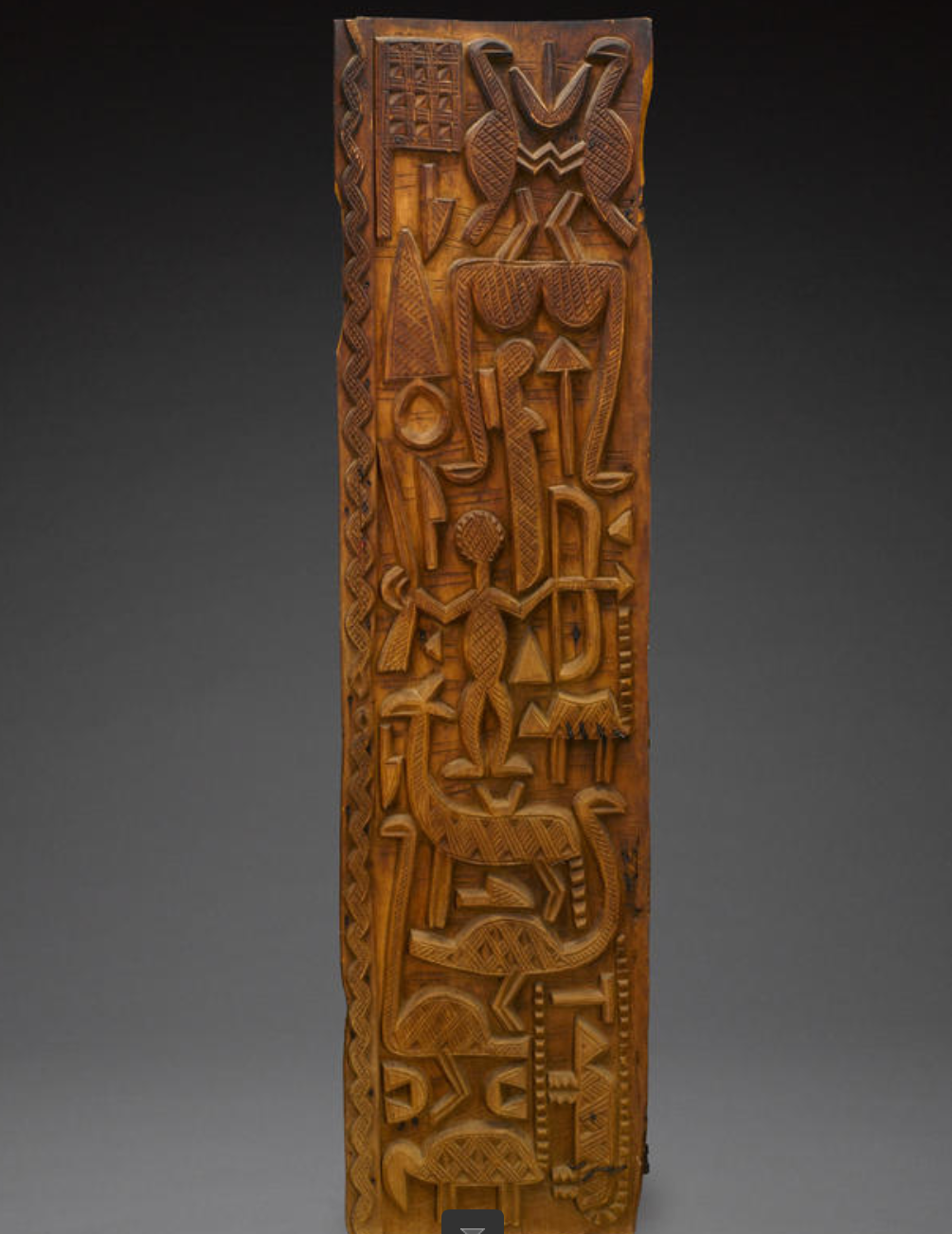
 Lot 162: The only piece in the sale with a Liberian provenance, this rare Grebo door once was owned by Yale and later by the Brooklyn Museum. Amazingly, it sent unsold (guide price $8000). 

 Lot 182: An incredible Ijo Mask from Nigeria, sold for $8125.

 Lot 187: An intricate Nupe Door from Nigeria, 
possibly attributable to the carver Sakiwa the Younger, sold for $3125.

  Lot 188: A gorgeous Mumuye figure from Nigeria, sold for $4375.
(profile view below)


 Lot 189 A Mambila ancestral figure from Cameroon or Nigeria, sold for $6250.

 Lot 210: A charismatic Pende Giwoyo Mask, from the DR Congo, with its comically solemn expression and grandfatherly beard, unsold (guide price $2500)

 Lot 215: A disk-shaped Mask, used in the Kidumu Society of the Tsai group 
of Teke people from the DR Congo

 Lot 218: A classic; the dynamically-featured Songye Mask, this item was photographed in 1972 in the Congo whence it was sourced(below). Sold for $3500.


Monday, November 4, 2013

New Air Cote D'Ivoire Flights to Monrovia

Looks like a posted the last report on regional airline flights a bit too soon. Just today, Air Cote D'Ivoire  announced a revised Winter schedule, which includes a brand-new Abidjan-Monrovia-Freetown service, three-times per week:


* Abidjan – Monrovia – Freetown NEW 3 weekly service from 22NOV13
HF762 ABJ1200 – 1325MLW1405 – 1450FNA 319 257
HF763 FNA1530 – 1615MLW1655 – 1820ABJ 319 257


Interestingly, the schedule refers to MLW, or Spriggs-Payne Airport, rather than RIA (here's one saying it is Spriggs, here's another saying its an Airbus to Robertsfield) Whether this is the actual choice of airport isn't certain as there is no other information on the airline's website. Also not clear what aircraft will be used, although it will likely be an Embraer 170 turboprop. Presumably, given the regional rules on flights, Air Cote D'Ivoire will be allowed to carrying passengers between Monrovia and Freetown.

Friday, November 1, 2013

Air Mano River Union?

A bit of a strange, and typically vague press report came out of the recent meeting between the Transport Ministers of the Mano River Union (Liberia, Sierra Leone, Guinea and Cote D'Ivoire) that stated, in part:

The Ministers of Transport of Liberia, Sierra Leone and Guinea have resolved to establish a common airlines to connect the three countries and ease the difficulty being experienced by inhabitants of the sub-region  because of the absence of connecting flights.    

It should be noted that presently none of these three countries has any domestic airline, unlike Ivory Coast, with its recently re-launched state carrier, Air Cote D'Ivoire. Perhaps that's why the MRU's newest and largest member state (which also does not straddle the Mano River) is not listed among the countries seeking to 'establish a common airline.'

The impracticalities of this scheme are evident: aviation anywhere is a costly endeavor; even in low-competition  Africa, continental giant Kenya Airways struggles to yield a profit. In the region, privately-backed, would-be Sierra Leonean state carrier Fly 6ix went bust with little fanfare, while news of an Arik-backed or government-back successor have gone silent.

The region remains a tiny market for commercial flights, with fewer seats departing Liberia in a week than are filled at most major airports in a quarter of a single hour. Furthermore, there is still very little need to connect the Mano River Union capitals with one another, much less for domestic flights. Since Brussels Airlines changed its schedule earlier in 2013, there has been no scheduled service between Abidjan, an urban center of 5 million, and Monrovia, just 2 hours away (Brussels airlines stops in Freetown as of last month). Likewise, Conakry and Monrovia were initially linked by Air France's service which it began in 2011, but that has now switched to a stop in Freetown. British Airways also flies to Freetown, although it doesn't have rights to drop passengers from Liberia in Sierra Leone. Despite all these widebody fights, there are still more frequencies to further-away Accra than next door Freetown.

ASKY Airlines, launched in 2009 by Ethiopian Airlines, and based out of Lomé, dominates scheduled flights across West Africa, albeit with tiny turboprops making a handful of flights a week, few of which hopscotch the Anglophone/Francophone checkerboard of West African countries. In April, a flight from Monrovia to Abidjan took 6 hours, as the only routing was on ASKY from Monrovia to Accra to Lomé, to a change of planes to reverse directions to Abidjan. This is the result of the current state of both the economics and regulations of the region, and ASKY has been successful in part because it boasts no particular national affiliation. Although national flag carriers will always be a point of pride for governments, they are expensive and impractical, especially for under-budgeted, underdeveloped countries.

Sunday, September 15, 2013

Grand Bassam: Ready for Tourists?

While preparing the posts about Françafrique earlier this month, it seemed serendipitous to hear my good friend and excellent journalist Tamasin Ford, the BBC West Africa correspondent based in Abidjan, on the BBC Africa Today podcast, filing a report about Grand Bassam, Cote D'Ivoire's original capital city.


Situated on the Atlantic Ocean, tiny Grand Bassam is about an hour southeast of Abidjan, and was the first capital of the French colony has been more recently something of the Newport, Rhode Island of Ivory Coast. As Tamasin reports, it has received UNESCO World Heritage status, but hasn't yet seen an influx of tourists. Listen to Tamasin's report on her Soundcloud page.

I happened to visit Grand Bassam in April this year, while visiting Tamasin and her boyfriend in Abidjan. Upon arriving from the city, we first went to a decent beachfront hotel for lunch. The beach was busy and the hotel was lively, although I didn't see that many foreigners; the majority of people seemed to be West African.


The three of us strolled to find the Vieux Carré after lunch. It was a bit hard to find, as there were no street signs or maps, and few wayfinding aides for the interested visitor. We experienced one of those strange sensations when visiting a foreign city, that particular disorientation when you have no idea if you've found the center of town or if you're on the outskirts, looking for something else.


Like several other colonial historic districts that I've visited in West Africa, Grand Bassam in its current, dilapidated condition, offers the visitors a rare chance to get up close to the architecture in its on-reconstructed state. Its amazing to be able to walk in these old buildings without restriction, such as the old railway station, below:


However, the bigger aspect is also the more negative: I was disappointed not so much at the sorry condition of the historic buildings, but it was obvious that several had already disappeared, and even the better examples that still stood, there was no way of learning more about them, such as the case with the magnificent example at the top of this post. The old center was interrupted by new construction, as would be expected in an inhabited district; some was more "contextual than others." In the bones of some of the older structures, the possibility for a refurbished, tourist-oriented destination seemed possible: fixing up a few for restaurants, cafés and small guest houses. Certainly sufficient crowds were coming to the area, as the beaches just ten minutes away were full of weekenders.


I am not familiar with what expertise or assistance UNESCO provides its designates, or whether a master plan or other aide is coming Grand Bassam's way. But there is a lot of work to be done to capture the potential of this historic city as a place for visitors, and much like the historic architecture of Liberia, as time passes, less and less of the older buildings are left standing.

All photos ©2013 Mathew M. Jones

Saturday, September 7, 2013

Francafrique on Al Jazeera

Following on the last post about the corruption scandal in Guinea, a recently-broadcast 3-part Al Jazeera documentary is especially well-timed (now that Al Jazeera America has launched and subsequently Al Jazeera's website has been blocked in the US, I may be just teasing Moved 2 Monrovia's American readers). This excellent three-part exposé, The France-Africa Connection, can be accessed online in three 45-minute episodes on the Al Jazeera website.


While reading up the topic will give interested viewers more depth into the long, sordid, shocking relationship between France and its colonies, documentary programming like this are electrifying for their vintage footage, however fleeting. Anyone interested in African history can only dream of having hours to look through all these archive news reels. 


In this respect, Episode Two is especially riveting, concentrating on the shocking "Elf Affair," which revealed how metropolitan French politics were infused with dirty money from oil exploitation from Francophone Africa, especially Gabon. Included here are brief glimpses of rare footage of Brazzaville, pockmarked by gunfire in the wake of the Nguesso-Lissouba conflict. 


Legendary prosecutor Eva Jolly also makes an appearance at the end, calmly recounting her life-risking exposure of the Elf scandal. 


All three episodes reference astonishing chapters in this complex, often ugly history, such as the mention in Episode 1 of the now openly-admitted poisoning of Cameroonian opposition candidate Félix Roland Moumié, and the counterfitting of the Guinean currency to destablise the regime of its democratically elected leader, as well as some disturbing retelling of the Biafran crisis, where France tried to undermine British power in the Gulf of Guinea.  
Across the entire broadcast, the grey-haired, liver-spocked old men, sitting in their gilded salons in Paris, could not be more frank in admitting to and confirming the malfeasance and shenangians that went on for decades in French West and Equatorial Africa, from Conakry to the Congo. 
One of the more compelling interviews is Jean Pierre Cot, who, as a young public servant was named Minister of Cooperation in the early days of the Mitterand cabinet. Having never been to Africa, much less positioned within the corruption networks, Cot's year in office was a rare, brief moment of reform, retold in his own words from 30-year old footage as a baby-faced Cot steps off an Air Afrique jet to visit a village, and speaks of a new era of fairness and partnership that never came.
The third episode is especially fascinating. In post-cold war era, as realpolitik pros age and die and new powers, especially China, arrive on the continent, and the traditions of feality to Paris slacken. The bonds with metropolitan France aren't exactly broken, but in some cases are reversed. 


Gabonese President Ali Bongo's endless suitcases of cash, stashed in corners of Crillion Hotel suites, not so much lubricated French party politics, but became one of the post important power nodes in the entire country, hand selecting freshman ministers across the political spectrum. Rather than simply being an industrial-commodity exploitation, now cash was the main extraction flowing out of Africa with the Presidents-for-life playing their former colonial masters.


Just as this bizarre arrangement reached its sprawling, viscous apex, its main underwriters, the founding father of Cote D'Ivoire and Françafrique itself, Hophouët-Biogny, passed away. The other pillar of Françafrique, Ali Bongo, died in 2009, succeeded by his son. 

This last episode includes several pristine panoramas of the Basilica in Yamoussoukro... 
...but more memorably features some shocking footage of the night-time bombing of Gbagbo loyalists on bridges Abidjan, and hundreds scattering and falling as French forces fire on protesters outside the Hotel Ivoire. 


Rather than being the final unravelling of Françafrique, the arrangement seems to live on in a post-classic form, as French intervened in the Gbagbgo-era Ivorian crisis, and its commercial tentacles still firmly grip the economic levers of West and Central Africa in the Sarkozy era, when ministers who spoke ill of Françafrique found themselves suddenly without portfolio.  While Hollande has declared a new era, French companies still operate ports and mines from Cote D'Ivoire to Congo. 


Tweets by @moved2monrovia